
Global Report
The Investment Double Whammy: Opportunities in London’s Investment Trust sector.
Learn more
Local Report
Can the JSE’s Rally Sustain Beyond Metals and Telcos?
Learn more
Market Indicators
Global and Local Indicators.
Learn more
Global Report: The Investment Double Whammy: Opportunities in London’s Investment Trust sector
By Nick Downing
There is unprecedented excitement in the London listed investment trust sector, driven by structural advantages, attractive valuations and a wave of corporate activity. These investment trusts, also known as investment companies, are public companies listed on the London Stock Exchange. They have independent boards to oversee governance, and assets are managed by fund managers. Underlying assets comprise exposure across global equity markets and alternative asset classes. There are over 300 investment companies in existence, with a combined market capitalisation of approximately £280 billion. They make up a third of the FTSE 250 by number of companies and there are five constituents of the FTSE 100 index.
The excitement is centred on a steady narrowing in the discounts of these investment companies. As discounts narrow, the share prices rise by more than the value of the underlying investments, creating a double whammy effect. Not only do investors gain from appreciation in the portfolio’s assets, but the closing gap to net asset value (NAV) also amplifies share price gains beyond the NAV growth. For instance, if a trust’s NAV rises by 5% while its discount shrinks from 15% to 10%, the share price could surge by around 11%, creating outstanding returns.
Historically, discounts have widened during periods of market stress, but the current cycle has been unusually prolonged. The sector’s average discount peaked at 19% in October 2023, the widest since the 2008-09 Global Financial Crisis, amid rising interest rates and economic uncertainty. Since then, the average discount has steadily narrowed to its current level of 13.5%, as the bargains on offer have attracted numerous investment institutions, activist investors and hedge funds, seizing the opportunity of acquiring high quality assets at a fraction of their intrinsic value.
US based hedge fund Saba Capital is the latest activist investor to shake up the investment trust sector, building significant stakes in several companies and forcing shareholder votes in at least seven with the aim of replacing the boards, merging the companies and taking over the fund management. All seven votes went against Saba Capital, but its CEO Boaz Weinstein is adamant that his assault is only just getting started. The onslaught by predatory investors has been a catalyst for a surge in corporate activity in the sector. 2024 marked a peak for mergers, acquisitions, share buybacks, tender offers, and managed wind-ups, with momentum carrying into 2025, which is on track to be the record year for corporate activity.
What makes investment companies particularly appealing is their shareholder-centric structure. The fund managers are mandated at the behest of the shareholders, which ultimately means they can be fired and replaced if performance is disappointing. There are numerous backstops for investors to ensure that wide discounts eventually narrow. Many investment companies offer periodic exit opportunities, which provide investors a chance to sell close to NAV, some offer periodic continuation votes, and strategic reviews, which can culminate in the company being acquired, merged or wound-up, normally at or close to NAV. All these forms of corporate activity invariably result in a re-rating in the shares. Share prices tend to close-in towards NAV as the corporate event approaches. Corporate events and all other forms of “discount control mechanism” essentially provide investors with a “free put option”, a downside protection akin to an insurance policy on the shares.
Another historic advantage over other forms of investment fund, is that they hold permanent pools of capital and are not under pressure from other investors to sell assets. This enables them to make long-term investments in illiquid securities such as unlisted shares, venture capital, infrastructure, specialised credit or hedging strategies. These so-called alternative asset classes make up 34% of the investment company universe by market capitalisation. Alternatives not only offer potential for higher returns (often outperforming public equities over decades) but also provide diversification, reducing correlation with volatile stock markets. For everyday investors, investment companies democratize access to these sophisticated strategies, which might otherwise require multimillion-pound commitments.
At OAM, we have leveraged this sector’s strengths since 2001, constructing global private client share portfolios around investment companies. This approach remains unique in South Africa, granting clients exposure to top-tier fund managers (such as BlackRock, Baillie Gifford or JPMorgan) and a mix of equities and alternative assets at discounts well below their fair value. With the global economy showing signs of resilience, bolstered by stabilising inflation, potential rate cuts, and rebounding growth in key markets, the outlook for further discount narrowing is bright. Emma Bird, head of investment trust research at Winterflood echoes this optimism: “There is considerable scope for average discounts to narrow back to single figures…. In a few years’ time, with the benefit of hindsight, I suspect some investors will be looking back at the returns they could have made and kicking themselves for not taking advantage.”
Risks persist, including geopolitical tensions, policy uncertainty, and the impact of trade tariffs. However, the average discount of the £280 billion investment company universe has narrowed steadily from 19% in October 2023, to 16% in December 2024, to its current level of 13.5%, and is likely to continue narrowing, as corporate activity intensifies and economic tailwinds strengthen, creating a rare double whammy for investors. Despite their recent narrowing, discounts are still wide by historical standards. Between 2012 and 2022, the average discount was consistently in the low single digits, suggesting we have considerably further to go in the current re-rating.
Local Report: Can the JSE’s Rally Sustain Beyond Metals and Telcos?
By Sean Fitzpatrick
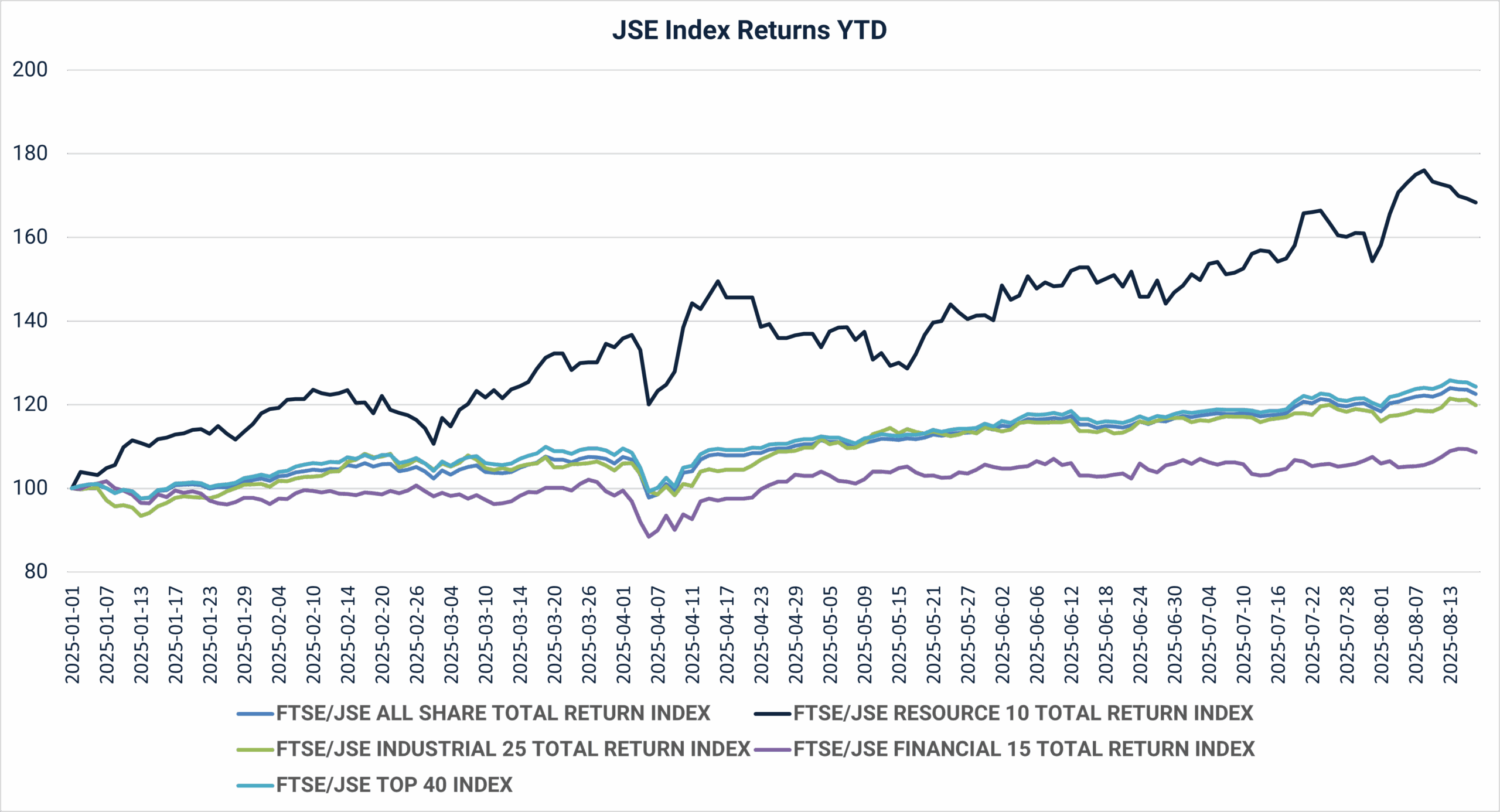
From a distance, the JSE has delivered an impressive performance so far in 2025. On a YTD basis the All-Share Index has climbed almost 21%, putting together five consecutive months of gains by the end of July. However, beneath the glossy surface the rally is far from evenly spread. The reality is that just over a third of constituent shares have managed double-digit gains this year, while almost 80% of them have underperformed the ALSI, and in many cases, even inflation. In other words, 2025 has not been a year where a ‘rising tide lifts all boats’, but one when owning the “right” few shares has mattered far more than owning the market as a whole. And for now, those “right” shares have overwhelmingly been precious metal miners and telecoms.
Precious Metals are leading the pack. If the JSE were a relay race, the gold and platinum miners would be the ones breaking the tape while the rest of the pack struggles to get out of the starting blocks. In the first quarter of 2025, gold miners surged on the back of reciprocal tariff announcements and a flood of uncertainty in global markets. Although platinum miners were behind in timing, they have been quick to catch up as the year has progressed, earning returns that most sectors would be thrilled to achieve in a decade. The momentum has continued. By the time of writing this article, the gold price is up 27% YTD, platinum 50%, and palladium 34% in USD terms. With miners being leveraged plays on the metals, individual ticker returns have skyrocketed. Data on platinum and its future trajectory is compelling. The World Platinum Investment Council projects persistent platinum supply deficits through to 2029. Albeit attractive, it is important to consider other metals that make up the PGM basket, namely palladium and rhodium. Gold, meanwhile, has enjoyed a healthy run from investors seeking shelter from trade disputes, geopolitical tensions, and currency volatility.
Hot on the miners’ heels are the telecoms, which have quietly called in some of the strongest returns in the market. As a sector, they are up circa 59% YTD. MTN Group has led the charge for the larger names with an 77% rise (even after the stumble they experienced yesterday), thanks to improved macro conditions in African markets, higher prices for data and voice services and renegotiated tower leases in Nigeria. Vodacom has maintained a steady upward course, bringing in 43% YTD, and Telkom’s strong results and dividend reinstatement propelled it 38% higher in June alone, helping support its YTD gains to 67%. But let’s not forget Blue Label telecoms. Although with a smaller overall market cap, the company has been a standout in 2025, returning just over 180% YTD. Why the appeal? In part, it’s the dependable cash flows that come with millions of subscribers glued to their devices, rain or shine. Not to mention the capex moat that surrounds these businesses. The industry is difficult to penetrate and requires significant infrastructure. In a market that has been short on predictable growth (with numerous downward GDP growth revisions locally), telecoms have filled the gap with steady, defensive performance.
A Rally Built on Narrow Breadth: The problem, of course, is that such leadership has been narrow. Out of 125 companies that make up the ALSI, just 28 have managed to outperform the JSE’s price return YTD. Broader ‘SA Inc. sectors’ such as retailers, construction companies, financial services, and industrials, have been treading water. That’s what makes this rally fragile. When most of the market is left behind, the risk of a sharp reversal grows: if the sectors in the lead stumble, there’s no one else to take the baton.
There are, however, some early signs that the rally could broaden. South Africa’s S&P Global composite PMI rose to 50.3 in July from 50.1 in June, nudging above the neutral 50 level and indicating modest private-sector expansion. The manufacturing PMI told a similar story, climbing to 50.8—the first reading above 50 in months. In short, businesses are slowly making and selling more than they did before. While this isn’t a signal of a boom, it’s the kind of improvement that often precedes a wider pickup in market confidence.
For the lagging sectors to join the party, a few things need to line up…and some already are. The South African Reserve Bank has trimmed interest rates three times this year, from 7.75% to 7.00%, with an unofficial commitment to target the lower bound of its 3–6% inflation range. That effectively anchors inflation expectations closer to 3%, giving the Bank more room to cut rates further. Lower borrowing costs tend to work their way through the economy in several ways: they lighten the load on indebted consumers, reduce the cost of capital for businesses, and often give property and retail sales a much-needed lift.
Structural reform is also quietly moving forward. Ports are clearing backlogs more quickly thanks to new equipment and better processes, and rail productivity has inched higher. Power supply, while far from perfect, has stabilised compared to the rolling blackouts of the past few years. These changes might not grab headlines, but they form the kind of operational backdrop in which consumer and investor sentiment can steadily improve.
If this improving sentiment is joined by additional rate cuts and a sustained pickup in PMI readings, it’s not hard to see broader sectors starting to regain ground. Domestic banks could benefit from stronger credit growth, retailers from rising disposable incomes, and construction and manufacturing from increased investment activity. Of course, such a shift would require the above-mentioned positives to outweigh any lingering headwinds of slow GDP growth, occasional political friction, and adverse tariffs imposed on South African exports to the United States. Markets have a knack of climbing walls of worry, and sentiment can turn more quickly than most expect.
Just as important as spotting the potential for a broader rally is recognising that the current leaders are not invincible. A stronger rand could weigh on the export earnings of resource companies. A resolution to global trade tensions could cool safe-haven demand for gold. If investor appetite shifts back towards riskier, domestic-facing shares, money could rotate out of telecoms and miners into other opportunities. In other words, the very factors that have created the concentrated gains of 2025 could just as easily unwind, leaving anyone overexposed to the winners nursing an uncomfortable drawdown.
In conclusion, the JSE’s 2025 story has been somewhat concentrated: a headline rally masking a market still waiting for most of its constituents to join in. For now, precious metals and telecoms carry the weight, but the potential for broader participation is present—lower rates, improving PMIs, ongoing reform, and a touch of consumer and investor optimism.
At Overberg Asset Management, we believe the most resilient portfolios are built through combining high-conviction stock picks with diversified ETF exposure. That way, investors are primed for continued leadership from current winners, while remaining ready for the rally to broaden without being overexposed to any single sector.
Market Indicators
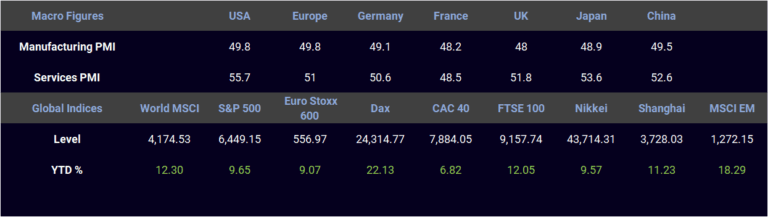
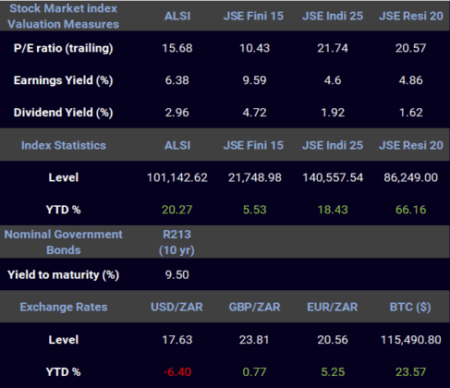
Make use of the many indicators below simply by clicking on each of the dropdown menus provided
Reference: Capital Economics – Historical bond and equity return data.
The Bottom Line: Innovation and the Magic of Compounding
By Carel La Cock
The oldest investment trust listed on the London Stock Exchange can trace its beginnings back to the surging demand for rubber at the advent of the car industry. Following the Panic of 1907 when the New York Stock Exchange fell nearly 50% from its peak, credit markets dried up and realising the opportunity to lend to rubber plantations in Asia, Colonel Augustus Baillie and Carlyle Gifford established The Straits Mortgage and Trust Company Limited that would ultimately become the behemoth: Scottish Mortgage Investment Trust (SMT), a constituent of the FTSE100.
Baillie Gifford & Co, the investment management company that stewards SMT, oversee total assets in the fund of £16.67bn as at the end of February 2022. Outgoing manager, James Anderson, defined his career with early investments in Amazon and Tesla, which propelled the fund to cumulative growth of 696.8% in the last 10-years, compared to 220.4% for its benchmark, the FTSE All-World Index. Anderson’s investment philosophy has always been based on the belief that technological improvements will drive innovation and that even picking a small number of these successful future companies and holding on to them long enough to let the magic of compounding work, will lead to exceptional returns for clients. Tom Slater, co-manager since 2015, will take over the reins at the end of April and believes that it matters less failing to sell the holdings you should sell, than selling the holdings you should not sell. When they go long on investments, they remain long offering support as patient investors often nurturing private holdings until they go public.
After a stellar performance in 2020 which saw net asset value (NAV) grow by 106.5%, 2021 was more subdued by its own standards, up only 13.2%. This year the share price has come under severe pressure from rising inflation and the rising interest rate used in discounting long duration income flows on many of the growth stocks in its portfolio. Moderna, the manufacturer of Covid-19 vaccines and the largest holding in the portfolio at 8% is down nearly a third year to date, while Tencent, the Chinese e-commerce giant, at 4% of the portfolio is down nearly a fifth this year. Others in the top five holdings: ASML (-13%), Illumina (-9.6%), Tesla (-13%) and NVIDIA (-10.4%) have all been downgraded due to expectations of a steepening yield curve.
Is now the time to panic and if not now, then when? Geopolitical risk is at an all-time high, the US federal reserve has just hiked interest rates for the first time since 2018 and global inflation is running rampant while oil and gas prices have spike on supply fears. However, listening to manager, Tom Slater and deputy manager, Lawrence Burns discuss the current environment and the outlook for the portfolio in a recent investor presentation, you don’t get the sense that now is the time to panic, or indeed ever. Their strategy is long-term, and they have positioned the fund to participate in structural changes and technological advances in society. They have incredible deal flow built on decades of strong relationships and a reputation for stability and patience. Entrepreneurs are keeping companies private for longer and having early access to investment in these opportunities often leads to extraordinary returns.
As for its current top holding, asked if Moderna is a “one-trick-pony” with reference to the major windfall from the Covid19 vaccine, but recently downgraded as investors see the end of the pandemic and the Covid-19 vaccine franchise, Lawrence answered “Moderna is a one trick pony, but that one trick is a broad and important one and that trick is mRNA.” The biotechnology behind the Covid-19 vaccine is a powerful one with programmes to cure zika, HIV, cancer and a range of other ailments making the recent windfall unlikely to be a once-off.
Regarding the tightening of regulation in the Chinese technology sector and its impact on Tencent, the team thinks that the Chinese government is ahead of the curve in terms of regulation and that democratic western nations will eventually implement similar regulatory changes. They believe that companies that “go with the grain of society” and who are aware of their broader impact on society will find it easier to prosper. In this regard, Chinese tech companies are further along the route of enlightenment.
Lastly, Tom Slater does not agree that higher inflation and rising interest rates should lead to lower valuations on growth stocks. He cautions investors to also consider the impact of pricing power on some of these high growth companies as they become market leaders in their field. Therefore, with higher expected future inflation, one should also adjust the future cash flows that will yield a better current valuation. Looking past the current volatility, the fund has invested in some ground-breaking technology and the managers are excited by the intersection of computing power and biology calling the opportunity set “large and varied” They have 49 investments in private companies, and it is not difficult to imagine the next Amazon and Tesla coming from that pool.
Invest Today
Spend some time with our team to find out which one of our portfolios is best for you!
