
Global Report
Raising exposure to China.
Learn more
Local Report
South Africa’s growth story: From glory to stagflation, and the road back.
Learn more
Market Indicators
Global and local indicators.
Learn more
Global Report: Raising Exposure to China
By Nick Downing
China has long been a speculative investment destination due to uncertainty over government attitudes toward the private sector and a collapsing property market. The benchmark Shanghai Shenzhen CSI 300 index remains 22% below its record high in February 2021 and has yet to surpass its 2015 peak. However, after various false starts, the cloud of pessimism is lifting, and China appears to be entering a steady and sustainable bull market. In local currency terms, the CSI 300 has strongly outperformed its global peers, delivering a year-to-date return of 19% compared to 11% for the S&P 500, 13% for the Nikkei, and 12% for the FTSE 100. In U.S. dollar terms, this outperformance is even more pronounced, bolstered by a 2.4% appreciation of the renminbi against the dollar.
Several factors are driving this shift. Beijing has prioritized economic growth and long-term stability, reducing policy uncertainty with a more supportive stance toward the private sector, particularly technology firms. A substantial fiscal stimulus, described by Deutsche Bank as the third largest relative to GDP, has been launched. Additionally, the People’s Bank of China is injecting liquidity into the economy through successive interest rate cuts and relaxed capital requirements for banks. Two structural policy initiatives complement these cyclical measures. First, the government is addressing industrial overcapacity, a key driver of excessive competition, which should improve corporate profit margins. Second, a significant shift toward boosting consumer spending marks a departure from reliance on exports and investment spending to drive economic growth. Tax subsidies on consumer loans are designed to stimulate household expenditure.
These policy shifts are encouraging, but broad-based earnings momentum is the key to the bull market. China’s economy grew by an impressive 5% in the first half of 2025, with full-year growth expected to maintain a similar pace. Economic activity has accelerated, driven by increased local bond issuance and bank credit. The property market, in recession for the past three years, is showing signs of stabilisation, reducing its drag on growth. Corporate earnings are improving across sectors, including the critical financial sector, providing a solid foundation for the equity market’s rise.
Domestic investors are primarily driving the rally, fuelled by loose monetary policy and record-low bank deposit rates and bond yields. With the property market—historically a competitor to equities—still subdued, households are turning to stocks. Property accounts for 74% of household wealth in China, while financial assets represent just 11%, compared to a global average of 30%. With household savings estimated at $22.3 trillion, there is significant potential for capital to flow into equities. In contrast, foreign investors remain cautious. Bank of America’s fund manager survey indicates persistent pessimism about China’s growth, with expectations at a three-year low. Goldman Sachs reports global mutual funds are underweight China by 3.1 percentage points as of August 2025. This negativity is a contrarian signal, suggesting the bull market may still be in its early stages.
China’s global leadership in artificial intelligence, highlighted by the Deepseek AI breakthrough in 2025, marks a turning point for the technology sector and broader productivity growth. The country now leads the world in many fields, with battery technology and electric vehicles notable examples. Independent research firm MRB forecasts China’s productivity growth at 3% annually over the next decade, compared to 1–1.5% for most developed economies and 2% for the U.S., offsetting sluggish population growth and increasing China’s projected share of global GDP.
While valuations in the U.S. and other developed markets are increasingly stretched, China’s equities remain deeply undervalued, trading at a 40% discount to global peers and a 50% discount to the U.S. on a forward price-to-earnings basis. This reflects the entrenched pessimism of recent years but presents a compelling opportunity. In the broader context of asset allocation, emerging markets, including China, are poised to outperform as the Federal Reserve cuts interest rates and the U.S. dollar weakens. Emerging markets with the greatest exposure to the digital economy are expected to do best as enthusiasm for AI continues to grow. China’s weighting in the technology, communication services, and digital retail sectors is a hefty 30% of the CSI 300 index.
Over the long term (10 years), China’s equity market is expected to deliver some of the highest annual returns globally. The clarity provided by recent economic and structural policy shifts has led Overberg Asset Management to initiate a position in Fidelity China Special Situations, an investment company listed on the London Stock Exchange, within our Global Balanced private share portfolios and to increase its exposure in our Global Growth portfolios. For more information, please contact us.
Local Report: South Africa’s growth story: From glory to stagflation, and the road back
By Sean Fitzpatrick
Once hailed as one of the world’s most promising emerging markets, South Africa rode a post-apartheid boom in the 1990s and early 2000s, at times growing more than 4 percent a year. But by 2019, that momentum had all but vanished, leaving the average South African poorer than before and the economy struggling to regain its spark. The Bureau for Economic Research (BER), in its September 2025 report Accounting for South Africa’s Remarkable Growth Deterioration, offers a clear diagnosis of how the country went from hopeful growth miracle to sluggish underperformer, as well as potential solutions on how we can find our way back.
Victory for the green and gold in the 90’s wasn’t reserved for the rugby field alone. The decade after the first democratic election came with optimism and sound policy choices. The government reined in spending, halved the debt-to-GDP ratio, and embraced inflation targeting, which anchored prices and helped bring down borrowing costs. At the same time, privatisations like Telkom and market liberalisation boosted competitiveness. The results were impressive. Annual growth accelerated from almost zero in the early 1990s to over 5 percent in the mid-2000s. This wasn’t only because more people were working, but also because those workers and businesses were becoming more productive. South Africans were making more with less. Foreign capital flowed in, manufacturing expanded, and the country’s exports became more complex and diversified. The South African economy was finding its place on the world stage.
Then came the reversal. The global financial crisis did not hit South Africa as hard as it did many countries, but the years that followed proved devastating for other reasons. At the heart of the story was state capture. Instead of investing in productive infrastructure, the government poured billions into mismanaged state-owned companies. Eskom, the poster child, doubled its capital stock between 2010 and 2019, building two enormous power stations, Medupi and Kusile. Yet, electricity output fell as corruption and mismanagement left the projects incomplete or defective. The result: load-shedding began, and with it, business confidence collapsed. By 2015, investment was stalling, and by the end of the decade, real investment had flatlined at around R500 billion per year.
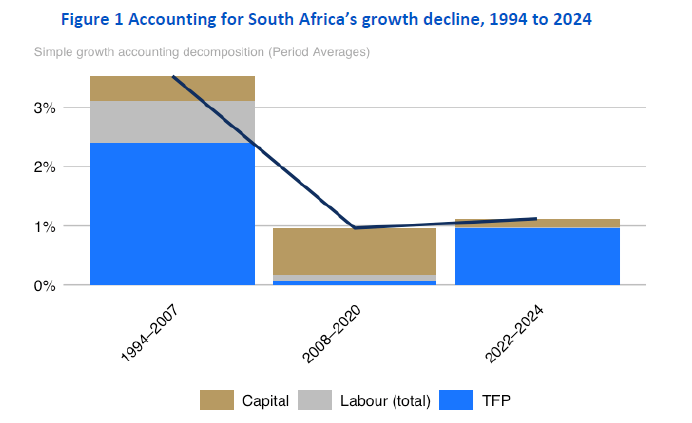
Figure 1: Accounting for South Africa’s remarkable growth deterioration, Bureau for Economic Research, September 2025.
The chart above, drawn from the BER’s analysis, tells the story with just a quick glimpse. Simply put, an economy’s growth is the product of capital (investment), labour and productivity (represented by ‘TFP’). In the 1990s and early 2000s, growth was driven by rising productivity, more investment, and a growing workforce. In other words – the winning formula. After 2008, productivity collapsed, and the labour force stopped contributing meaningfully to growth. Although the contribution of the capital stock remained relatively high initially, it began declining from 2015. The BER estimated that by 2019, South Africa’s potential growth rate, the speed at which the economy can grow without overheating, had fallen to near zero. In other words, the country had lost its ability to expand in a sustainable way. Any attempt at stimulating demand simply triggered inflation rather than creating lasting jobs or output.
The pandemic made a bad situation worse. In 2020, GDP collapsed by 6.3 percent, and though the economy rebounded in 2021, the recovery was uneven. Productivity improved as businesses adapted, but investment failed to return. By 2024, capital stock growth was running at just 0.4 percent a year, with investment shrinking rather than growing in real terms. Meanwhile, the country’s structural problems worsened. Load-shedding reached its peak in 2023, shaving almost two percentage points off GDP growth according to National Treasury. Logistics issues continued; rail freight volumes, which had peaked in 2015, declined steadily, while port throughput stagnated despite high global commodity prices. Transnet, once a backbone of South Africa’s trade, had become a bottleneck. By 2025, business confidence had sunk further. The BER’s surveys show that more than 60 per cent of firms are dissatisfied with current conditions, citing “red tape,” “service delivery,” and “political uncertainty” as their biggest concerns.
Looking back, one must ask “What went wrong?” and possibly a more important question of “How can we get back?”. Let’s start with the former. Three forces combined to drag South Africa down…First, misallocation of resources. Eskom and other state-owned enterprises absorbed vast sums of cash but delivered little in return, diverting money away from productive private investment. Second, policy drift. Fiscal expansion went largely into public sector wages, not infrastructure, while rising taxes and debt left little room for manoeuvre. Third, a confidence crisis. Political uncertainty, corruption, and governance failures eroded trust, scaring off investors both foreign and domestic.
The outcome was a country that de-diversified instead of modernising. South Africa’s ranking on the global economic complexity index fell from 34th in 2000 to 59th today, reflecting a shift away from sophisticated, knowledge-intensive exports towards more basic, less competitive products.
Moving on to a potential solution. The BER is not entirely pessimistic. It argues that South Africa has turned around its fortunes before and can do so again. The reforms of the 1990s are proof. If the country can deliver on long-delayed restructuring of state-owned enterprises, especially Eskom and Transnet, restore macroeconomic credibility, and cut back on red tape, investment could return to our shores. In its scenarios, the BER finds that accelerated reforms could lift investment growth by around 2 percentage points per year, pushing overall GDP growth towards 3 percent within five years. That may sound ambitious given multiple downward revisions to growth this year, but it is possible.
Some positive steps have already been taken. Concessions to private operators at ports and on rail are under way. Eskom’s unbundling has begun, albeit slowly. Water infrastructure is being opened to public-private partnerships. A small primary budget surplus has been achieved for two years running. These are signs of progress, but they remain too limited to change the country’s trajectory without a more determined push.
Let’s get down to brass tacks. What does this mean for your local portfolio and is there an optimal long term investment strategy? The findings above point to a dual strategy – combine global and local exposure. Global allocation in a portfolio must remain the anchor. Exchange-traded funds tracking US and global technology companies provide exposure to structural growth in artificial intelligence, cloud computing and digital infrastructure. Emerging market ETFs, especially those focused on China, offer tactical opportunities where policy stimulus supports demand.
The local book must be more selective. Broad JSE exposure offers limited upside in a low-growth economy. Instead, investors should concentrate on companies with operations linked to global earnings, those which are increasing market share, or those positioned to benefit from reform. Naspers and Prosus remain key gateways to global technology through Tencent. Not to mention the strides that Prosus has been making over the past year under its new leadership. Glencore provides diversified commodity exposure, while Afrimat is increasingly tied to infrastructure and construction demand that could accelerate under reform. Pepkor, with its strong management, large client base and growing fintech, offers a resilient consumer play. A holding such as Capitec offers exposure to a strong financial institution with incredible growth and value-added services.
At Overberg Asset Management we follow the above formula. By combining global ETFs and local tickers in our model portfolios, our clients benefit from having exposure to high growth economies, while still positioned to capture gains from standout players on the JSE.
Market Indicators
Make use of the many indicators below simply by clicking on each of the dropdown menus provided
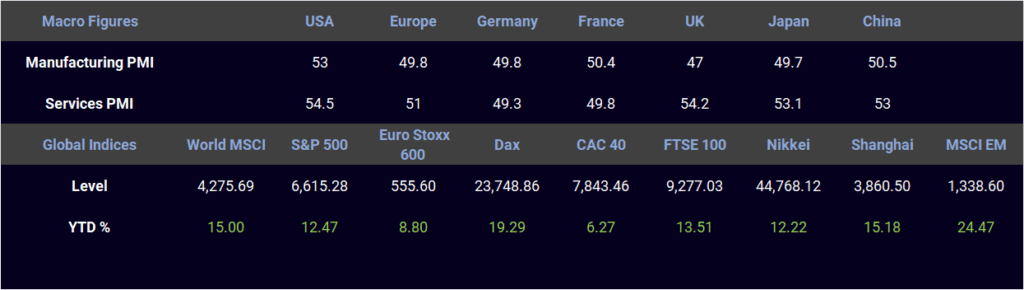
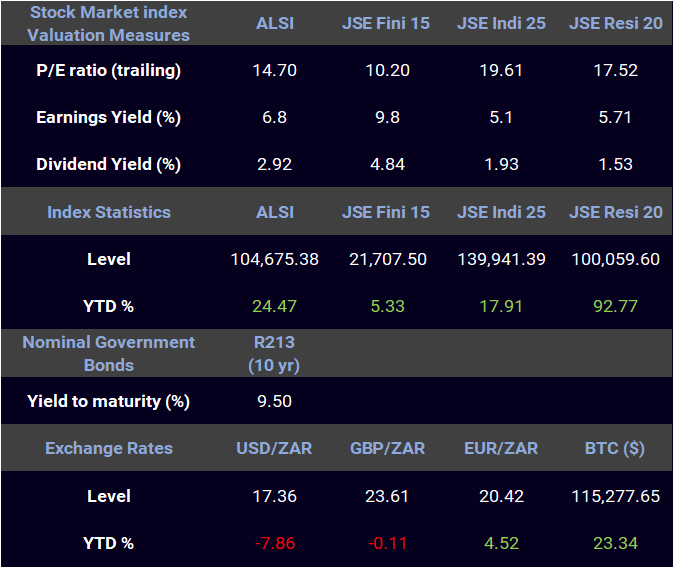
Reference: Capital Economics – Historical bond and equity return data.
The Bottom Line: Innovation and the Magic of Compounding
By Carel La Cock
The oldest investment trust listed on the London Stock Exchange can trace its beginnings back to the surging demand for rubber at the advent of the car industry. Following the Panic of 1907 when the New York Stock Exchange fell nearly 50% from its peak, credit markets dried up and realising the opportunity to lend to rubber plantations in Asia, Colonel Augustus Baillie and Carlyle Gifford established The Straits Mortgage and Trust Company Limited that would ultimately become the behemoth: Scottish Mortgage Investment Trust (SMT), a constituent of the FTSE100.
Baillie Gifford & Co, the investment management company that stewards SMT, oversee total assets in the fund of £16.67bn as at the end of February 2022. Outgoing manager, James Anderson, defined his career with early investments in Amazon and Tesla, which propelled the fund to cumulative growth of 696.8% in the last 10-years, compared to 220.4% for its benchmark, the FTSE All-World Index. Anderson’s investment philosophy has always been based on the belief that technological improvements will drive innovation and that even picking a small number of these successful future companies and holding on to them long enough to let the magic of compounding work, will lead to exceptional returns for clients. Tom Slater, co-manager since 2015, will take over the reins at the end of April and believes that it matters less failing to sell the holdings you should sell, than selling the holdings you should not sell. When they go long on investments, they remain long offering support as patient investors often nurturing private holdings until they go public.
After a stellar performance in 2020 which saw net asset value (NAV) grow by 106.5%, 2021 was more subdued by its own standards, up only 13.2%. This year the share price has come under severe pressure from rising inflation and the rising interest rate used in discounting long duration income flows on many of the growth stocks in its portfolio. Moderna, the manufacturer of Covid-19 vaccines and the largest holding in the portfolio at 8% is down nearly a third year to date, while Tencent, the Chinese e-commerce giant, at 4% of the portfolio is down nearly a fifth this year. Others in the top five holdings: ASML (-13%), Illumina (-9.6%), Tesla (-13%) and NVIDIA (-10.4%) have all been downgraded due to expectations of a steepening yield curve.
Is now the time to panic and if not now, then when? Geopolitical risk is at an all-time high, the US federal reserve has just hiked interest rates for the first time since 2018 and global inflation is running rampant while oil and gas prices have spike on supply fears. However, listening to manager, Tom Slater and deputy manager, Lawrence Burns discuss the current environment and the outlook for the portfolio in a recent investor presentation, you don’t get the sense that now is the time to panic, or indeed ever. Their strategy is long-term, and they have positioned the fund to participate in structural changes and technological advances in society. They have incredible deal flow built on decades of strong relationships and a reputation for stability and patience. Entrepreneurs are keeping companies private for longer and having early access to investment in these opportunities often leads to extraordinary returns.
As for its current top holding, asked if Moderna is a “one-trick-pony” with reference to the major windfall from the Covid19 vaccine, but recently downgraded as investors see the end of the pandemic and the Covid-19 vaccine franchise, Lawrence answered “Moderna is a one trick pony, but that one trick is a broad and important one and that trick is mRNA.” The biotechnology behind the Covid-19 vaccine is a powerful one with programmes to cure zika, HIV, cancer and a range of other ailments making the recent windfall unlikely to be a once-off.
Regarding the tightening of regulation in the Chinese technology sector and its impact on Tencent, the team thinks that the Chinese government is ahead of the curve in terms of regulation and that democratic western nations will eventually implement similar regulatory changes. They believe that companies that “go with the grain of society” and who are aware of their broader impact on society will find it easier to prosper. In this regard, Chinese tech companies are further along the route of enlightenment.
Lastly, Tom Slater does not agree that higher inflation and rising interest rates should lead to lower valuations on growth stocks. He cautions investors to also consider the impact of pricing power on some of these high growth companies as they become market leaders in their field. Therefore, with higher expected future inflation, one should also adjust the future cash flows that will yield a better current valuation. Looking past the current volatility, the fund has invested in some ground-breaking technology and the managers are excited by the intersection of computing power and biology calling the opportunity set “large and varied” They have 49 investments in private companies, and it is not difficult to imagine the next Amazon and Tesla coming from that pool.
Invest Today
Spend some time with our team to find out which one of our portfolios is best for you!
