
Global Report
Equity bull market has further to run.
Learn more
Local Report
The difference between a track record of 24 years and too-good-to-be-true trends.
Learn more
Market Indicators
Global and Local Indicators.
Learn more
Global Report: Equity bull market has further to run
By Nick Downing
Legitimate concerns exist that global equity markets, particularly in the US, are overvalued. Valuation risks are amplified by unprecedented concentration in the S&P 500, where the top 10 stocks — all heavily tied to the AI theme — now account for 40% of the index. Any unwinding of the AI boom would have systemic implications, making the sector worthy of close scrutiny.
The S&P 500 currently trades at a forward 12-month price-to-earnings (P/E) multiple of 23x, well above its long-term average of 17x. Technology valuations are even more stretched, surpassed only during the dotcom bubble. On a cyclically adjusted P/E (CAPE) basis, US technology stocks stand at 39x — below the dotcom peak of 44x but still extreme.
Additional red flags include circular funding arrangements (e.g., Nvidia leasing chips in exchange for equity stakes in customers) and rising corporate debt levels, raising questions about the sustainability of revenue growth.
Yet the picture is not as alarming as headline valuations suggest. Today’s AI leaders boast far stronger balance sheets than their dotcom-era counterparts. More importantly, the equity risk premium for the technology sector — earnings yield minus the real 10-year TIPS yield — stands at around +2%, compared with -2% at the height of the dotcom mania. In relative terms, valuations are considerably less demanding than during the previous transformative technology wave.
Scepticism persists about whether massive AI investment will deliver the promised productivity gains. The data, however, are encouraging: US non-financial sector productivity is currently growing at ~3.5% year-on-year — well above the long-term average of 2% and the 1.7% seen over the past decade. Technology hardware investment is rising 20% y/y and software 10% y/y. Historically, general-purpose technologies required many years of sustained investment before productivity benefits fully materialised; we appear to be only in the early innings.
Tech giants continue to signal robust capital spending in coming quarters. Capital Economics forecasts US business investment growth of 4.7% in 2026 and 5.2% in 2027, supporting S&P 500 targets of 7,000 by end-2025 and 8,000 by end-2026 — implying further double-digit returns. The latter assumes forward earnings of $320 matched with a (dotcom-peak) 25x multiple.
We remain vigilant. Pressure on revenue growth or margins — whether from softening demand, semiconductor shortages, data-centre constraints, or disruptive innovation (e.g., China’s rapid progress, illustrated by DeepSeek’s January 2025 LLM release) — could pose risks.
Broader equity optimism is supported by an improving global growth outlook, expected fiscal stimulus in the US and Eurozone, and monetary easing by most G7 central banks (except Japan). Widespread earnings growth combined with abundant liquidity remains a powerful tailwind.
History shows that the most reliable and timely warnings of bear markets come not from equity markets themselves but from bond and credit markets, which are more liquid, institutionally dominated, and risk averse. High-yield and investment-grade spreads remain historically tight, showing no recessionary stress — in sharp contrast to 1998–99 and mid-2007, when spreads widened well before equities peaked.
The more probable end to the bull market would be a sharp rise in long-term government bond yields, potentially triggered by sticky inflation, stronger-than-expected growth, tariff effects, or renewed fiscal concerns. Every major peak in the US 10-year Treasury yield this decade has forced equity de-rating; the last episode (2022) saw the S&P 500 fall 25% as yields approached 5%. A decisive break above that level would again drain global liquidity and raise discount rates, pressuring asset prices.
Some assets — notably gold and cryptocurrencies, especially Bitcoin — have entered bubble territory, driven by liquidity and risk appetite. A violent reversal in these pro-cyclical barometers would serve as an early warning of broader risk-off conditions.
For now, none of our leading indicators flash imminent danger. We expect the bull market to persist over the next twelve months as earnings continue to grow. While froth is evident in pockets, the greater risk remains being out of equities rather than in them.
As Peter Lynch famously observed: “Far more money has been lost by investors preparing for corrections, or trying to anticipate corrections, than has been lost in the corrections themselves.”
Local Report: The difference between a track record of 24 years and too-good-to-be-true trends
By Sean Fitzpatrick
South Africans are making 100% return on investment per month doing this! DON’T MISS THIS OPPORTUNITY TODAY.
Sounds too good to be true, right? If the introductory line of this article made you just a tad curious, you are not alone. South Africans have always had a taste for risk. Whether it’s a punt on the rugby score this weekend or a speculative hot tip shared in a WhatsApp group, we’re a nation of optimists who wants to believe ‘this time it’ll work out’. But in recent years, the line between gambling and investing has become blurred. Online gambling has boomed, while questionable investment schemes promising guaranteed returns continue to pop up on apps like TikTok and Telegram. Both offer the same seductive promise – instant wealth with minimal effort. Unfortunately, they often end the same way … with disappointment. As professional investors, we think it’s time to call it what it is: a wolf dressed in sheep’s clothing.
South Africa’s gambling industry has exploded. In the 2024/2025 financial year, total gambling revenue hit R1.5 trillion (including roll over bets). According to surveys, almost half of South Africans (49%) have placed a sports bet in the past year, and 35% do so online. Over half of regular gamblers say they bet because they need the money, not because they enjoy the game. That says a lot about the broader economic environment and about how hope is being monetised. Even with inflation under control and the SARB cutting interest rates since September 2024, unemployment remains above 30%, so it isn’t inconceivable to think your average South African will take some risks to make ends meet.
The same psychology underpins the surge in “miracle investment” schemes. Scroll through social media and you’ll find dozens of self-proclaimed experts promising to double your money in 30 days through forex trading, crypto mining, or AI-driven arbitrage. They post screenshots of luxury cars, vacation penthouses, and testimonials from supposed clients who “started with R5 000 and now earn R50 000 a month.” The sales pitch is intoxicating, and for many South Africans desperate for financial progress in a tough environment, it’s irresistible.
Gone are the days of walking into a physical casino to experience the fuzzy carpet, bright lights and general sensory overload. Smartphones have become the medium of choice, with online gambling growing at a rate of 47% per year since 2021. When it comes to false investment pundits, roulette wheels were replaced with video reels. The formula is always the same – a well edited video, fake urgency and an emotional hook. “This opportunity won’t last.” “Change your life today.” The algorithms know what they’re doing, and so do the scammers. According to the Association for Savings and Investment South Africa (ASISA), the number of reported fraud and dishonesty cases in the investment sector surged 26% last year. Telegram and WhatsApp groups now host entire communities of victims lured into Ponzi-style investment clubs. These scams don’t just steal money, they erode trust. They make legitimate investing, and financial professionals look boring by comparison. But that’s exactly the point! True investing isn’t about adrenaline. It’s about understanding, having an appropriate long-term strategy, and patience.
At Overberg Asset Management (OAM), we don’t buy into companies because they are trending or because someone on social media said they’re “the next big thing.” We build portfolios one company at a time, and only after we truly understand what we’re buying.
That means digging into the following (to name a few):
• Revenue drivers: Where does the company make its money? Is it sustainable, diversified, and supported by competitive advantages?
• Risks: What could go wrong with the company? How cyclical is the business? What internal and external factors can impact their profitability?
• Financial health: What does the company balance sheet look like? Is cash flow strong and consistent? How well does the company service their debt?
Every investment decision made in the local portfolios at OAM is the result of analysis, conversation and deciding how well it fits into the overall portfolio. We read financial statements, follow company developments, attend results webinars, keep a keen eye on macroeconomic indicators and assess industry trends. Our goal is to invest in real businesses that produce real profits over time, not promises. You would be correct if you said it isn’t glamorous. There are no flashing lights and no “guaranteed 50% returns”. But there is a track record – one built on decades of disciplined investing through every kind of market environment.
There is a reason compounding is seen as the 8th wonder of the world. Yes, it does take time, and there are both ups and downs. However, compounding is the real driver of wealth, and it rewards those who stick around. Exponentially.
A R100 000 investment that grows 10% per year doesn’t double in one year; it doubles in about seven (ie. The rule of 72). But it also doesn’t disappear overnight. Real investing rewards patience, not panic. Compare that with the gambler’s logic of “one good win, and I’m set.” The problem is, in both gambling and get-rich schemes, the odds are rarely in your favour, and the house always wins. When markets move against a legitimate investor, there’s an underlying asset, a strategy and a plan. When a scheme collapses or the aviator plane disappears from your screen, there’s nothing left but screenshots, tears and regret.
If you remember nothing else, remember these warning signs of an investment scam:
Guaranteed returns > there is no such thing as a risk-free investment
Unlicensed operators > always check FSCA registration.
If you are required to recruit other investors to realise your returns > sign of a pyramid scheme
Pressure to act fast > legitimate firms give you time to think and understand what they are providing.
Opaque strategies > if they can’t explain how the money’s made or what the underlying assets are, it may be wise to look elsewhere.
Ask any reputable finance professional, and they will tell you the same thing – transparency is everything. When you invest through a licensed, credible firm, you’re not just buying into performance, you’re buying into the company’s governance, compliance, and accountability. Most of all, you are trusting them to look after your hard-earned money and hopefully grow it consistently.
It’s easy to laugh at those who fall for scams until you realise how sophisticated they’ve become. In 2025, financial clickbait looks professional, convincing, and is everywhere online. That’s why the most important decision any investor can make isn’t what to invest in, but who to trust. At Overberg Asset Management, we see ourselves as stewards for our clients’ financial journey. We focus on long-term, transparent, risk-adjusted growth in our model portfolios. We communicate openly, comply with all applicable regulations, and invest only in what we understand. Consistent returns may not attract a million website clicks per day, but we know it works.
So, the next time an ad promises “R10 000 in 10 days,” or you’re tempted to open your favourite sport betting app at halftime, pause for a moment. Ask yourself: is this investing, or am I being invited to role the digital dice? Because the difference between gambling and investing isn’t luck. It’s discipline, process, and trust. If you get that right, you won’t need a winning streak to grow your wealth.
Market Indicators
Make use of the many indicators below simply by clicking on each of the dropdown menus provided
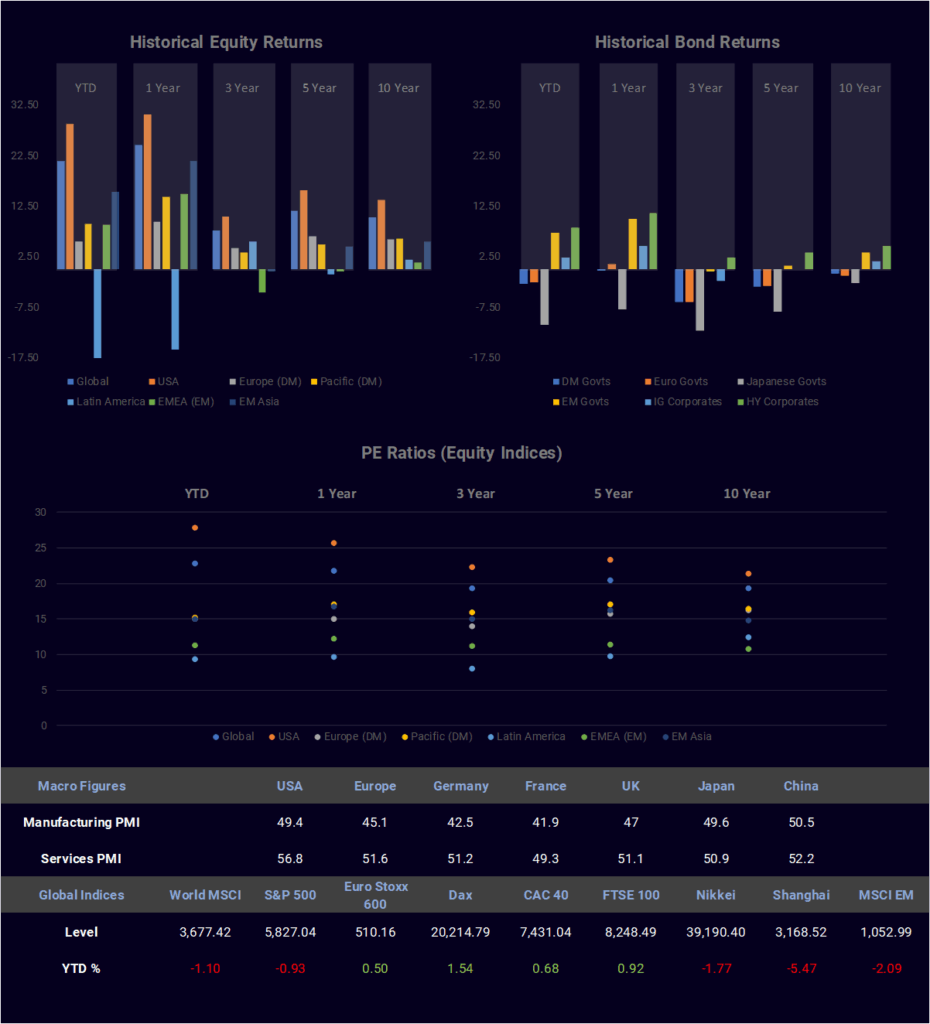
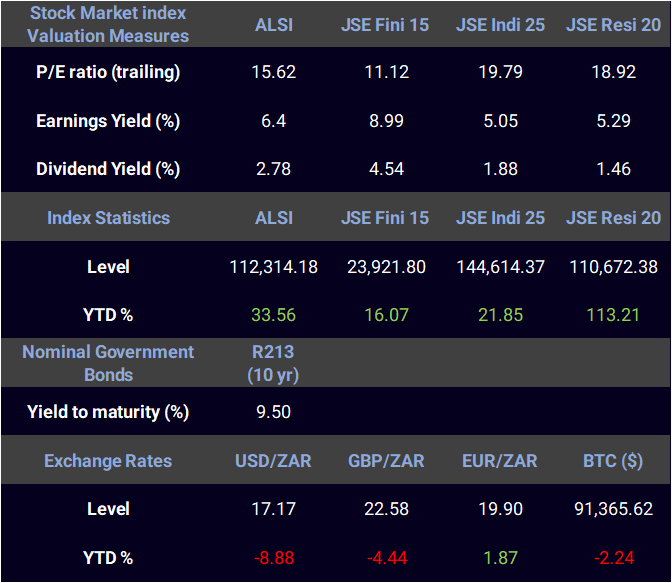
Reference: Capital Economics – Historical bond and equity return data.
The Bottom Line: Innovation and the Magic of Compounding
By Carel La Cock
The oldest investment trust listed on the London Stock Exchange can trace its beginnings back to the surging demand for rubber at the advent of the car industry. Following the Panic of 1907 when the New York Stock Exchange fell nearly 50% from its peak, credit markets dried up and realising the opportunity to lend to rubber plantations in Asia, Colonel Augustus Baillie and Carlyle Gifford established The Straits Mortgage and Trust Company Limited that would ultimately become the behemoth: Scottish Mortgage Investment Trust (SMT), a constituent of the FTSE100.
Baillie Gifford & Co, the investment management company that stewards SMT, oversee total assets in the fund of £16.67bn as at the end of February 2022. Outgoing manager, James Anderson, defined his career with early investments in Amazon and Tesla, which propelled the fund to cumulative growth of 696.8% in the last 10-years, compared to 220.4% for its benchmark, the FTSE All-World Index. Anderson’s investment philosophy has always been based on the belief that technological improvements will drive innovation and that even picking a small number of these successful future companies and holding on to them long enough to let the magic of compounding work, will lead to exceptional returns for clients. Tom Slater, co-manager since 2015, will take over the reins at the end of April and believes that it matters less failing to sell the holdings you should sell, than selling the holdings you should not sell. When they go long on investments, they remain long offering support as patient investors often nurturing private holdings until they go public.
After a stellar performance in 2020 which saw net asset value (NAV) grow by 106.5%, 2021 was more subdued by its own standards, up only 13.2%. This year the share price has come under severe pressure from rising inflation and the rising interest rate used in discounting long duration income flows on many of the growth stocks in its portfolio. Moderna, the manufacturer of Covid-19 vaccines and the largest holding in the portfolio at 8% is down nearly a third year to date, while Tencent, the Chinese e-commerce giant, at 4% of the portfolio is down nearly a fifth this year. Others in the top five holdings: ASML (-13%), Illumina (-9.6%), Tesla (-13%) and NVIDIA (-10.4%) have all been downgraded due to expectations of a steepening yield curve.
Is now the time to panic and if not now, then when? Geopolitical risk is at an all-time high, the US federal reserve has just hiked interest rates for the first time since 2018 and global inflation is running rampant while oil and gas prices have spike on supply fears. However, listening to manager, Tom Slater and deputy manager, Lawrence Burns discuss the current environment and the outlook for the portfolio in a recent investor presentation, you don’t get the sense that now is the time to panic, or indeed ever. Their strategy is long-term, and they have positioned the fund to participate in structural changes and technological advances in society. They have incredible deal flow built on decades of strong relationships and a reputation for stability and patience. Entrepreneurs are keeping companies private for longer and having early access to investment in these opportunities often leads to extraordinary returns.
As for its current top holding, asked if Moderna is a “one-trick-pony” with reference to the major windfall from the Covid19 vaccine, but recently downgraded as investors see the end of the pandemic and the Covid-19 vaccine franchise, Lawrence answered “Moderna is a one trick pony, but that one trick is a broad and important one and that trick is mRNA.” The biotechnology behind the Covid-19 vaccine is a powerful one with programmes to cure zika, HIV, cancer and a range of other ailments making the recent windfall unlikely to be a once-off.
Regarding the tightening of regulation in the Chinese technology sector and its impact on Tencent, the team thinks that the Chinese government is ahead of the curve in terms of regulation and that democratic western nations will eventually implement similar regulatory changes. They believe that companies that “go with the grain of society” and who are aware of their broader impact on society will find it easier to prosper. In this regard, Chinese tech companies are further along the route of enlightenment.
Lastly, Tom Slater does not agree that higher inflation and rising interest rates should lead to lower valuations on growth stocks. He cautions investors to also consider the impact of pricing power on some of these high growth companies as they become market leaders in their field. Therefore, with higher expected future inflation, one should also adjust the future cash flows that will yield a better current valuation. Looking past the current volatility, the fund has invested in some ground-breaking technology and the managers are excited by the intersection of computing power and biology calling the opportunity set “large and varied” They have 49 investments in private companies, and it is not difficult to imagine the next Amazon and Tesla coming from that pool.
Invest Today
Spend some time with our team to find out which one of our portfolios is best for you!
