
Global Report
Global Market Review and Strategy Outlook.
Learn more
Local Report
Local Market Review and Strategy Outlook.
Learn more
Market Indicators
Global and Local Indicators.
Learn more
Global Report: Global Market Review and Strategy Outlook
By Nick Downing
Contrary to expectations earlier in the year when President Trump shocked markets with his “Liberation Day” reciprocal tariffs, global economic growth proved remarkably resilient in 2025, testimony to the strength of supply chains and strong underlying demand. Despite the trade war, global trade volumes indeed expanded over the year. As the year progressed, market anxiety shifted from the threat of recession to a potential bubble in AI stocks. Market leader Nvidia’s third quarter (Q3) results massively exceeded all forecasts, and yet its stock price fell. A worrying divergence in the performance of the Magnificent-Seven stocks signalled increasing scrutiny from investors, amid questions over the accounting treatment of AI investment and the rising use of debt to fund it.
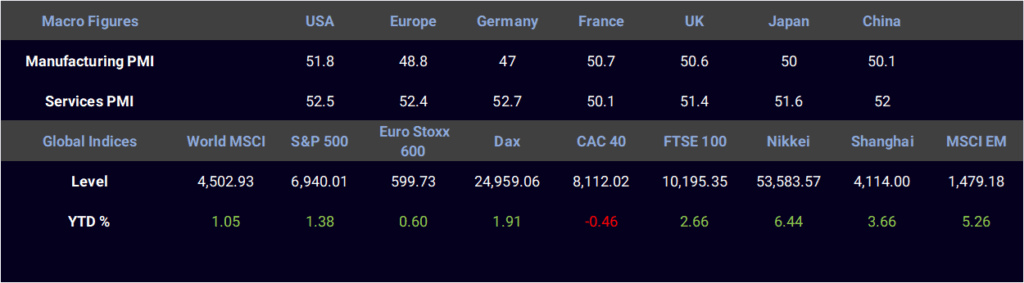
AI fatigue, combined with a broadening in global economic momentum led US equity markets to underperform their global peers in the past year. A weakening US dollar amplified the trend. The US dollar index gained in Q4 by 0.6% but lost 9.8% over the year. Despite underperforming, the S&P 500 index scaled numerous record highs during the year, rising a further 2.3% in Q4, capping a 16.4% annual gain. However, Japan’s Nikkei surged 12.0% in Q4 and 26.2% over the year, Germany’s Dax by 2.6% and 22.6%, respectively, and the UK’s FTSE 100 by 6.2% and 21.5%. China’s CSI 300 index consolidated its strong Q3 gains and lost 0.2% in Q4 but rose 16.3% over the year. The MSCI All Country World index (dollar-based) continued its march higher in Q4, with a 3.0% gain lifting its annual return to 19.8%, although emerging markets led the way, helped by cyclical and structural tailwinds as well as the weakening dollar, pushing the MSCI Emerging Market index (dollar-based) 4.3% higher in Q4 and by an impressive 32.9% in 2025. The S&P Global Developed Sovereign Ex-US bond index is also dollar based, which helped it achieve an 8.8% return over the year, despite its 1.3% loss in Q4. The US 10-year Treasury bond yield eased from 4.59% at the end of 2024 but in Q4 traded sideways to finish the year at 4.16% almost unchanged from its end Q3 level even though the Federal Reserve cut the fed funds rate twice over the quarter by 25 basis points in October and in December.
Despite its relative underperformance, the US remained the engine of global economic growth. Its GDP registered an above trend growth rate of 4.3% quarter-on-quarter annualised in Q3, accelerating from 3.8% in Q2, powered by strong consumer demand and robust business spending, led by the AI investment boom. While Q4 growth will be affected by the US government shutdown, growth is expected to build momentum in 2026, with a further Fed rate cut and the One Big Beautiful Bill Act providing combined monetary and fiscal stimulus. At its December policy meeting, the Fed lifted its GDP growth forecast for 2026 to 2.3%, up from its 1.8% forecast given in September. The Fed simultaneously lowered its 2026 inflation forecast, citing stronger productivity growth. Elsewhere, cyclical and structural conditions in the eurozone, Japan and emerging markets have been gradually improving. Eurozone GDP growth improved from 0.1% quarter-on-quarter in Q2 to 0.3% in Q3, with both monetary policy easing and significant fiscal stimulus expected to lift the growth rate in 2026. In Japan, GDP contracted in Q3 due to tariff effects but rising household disposable income, and fresh fiscal support under new Prime Minister Sanae Takaichi, will boost economic activity. Emerging markets should flourish amid improving global trade, broadening growth and a weakening dollar. Forward-looking global composite purchasing managers’ indices (PMIs) are well in expansionary territory across global regions, signalling strong and broadening growth ahead. According to IMF projections, global growth will achieve 3.1% in 2026, with advanced economies expanding around 1.5-2.0%, and emerging economies by around 4%.
Healthy earnings growth is expected to derive from the positive global economic outlook. Global earnings are projected to rise by 14% in 2026 according to consensus forecast, with aggregate double-digit gains in both US and global ex-US economies, although earnings growth expectations are highest in emerging markets and the eurozone, both enjoying the biggest recent upgrades to estimates. Both fiscal and monetary conditions are conducive to upside growth surprises. In the US, eurozone, China and Japan, governments are primed to launch fiscal stimulus. Meanwhile, the Fed cut its fed funds rate by a total of 75 basis points between September and December, with a further rate cut expected in June after the new Chair takes over with the expiry of Jerome Powell’s term in May. In December, the Fed announced a resumption of asset purchases, formerly known as quantitative easing. Other central banks are close to if not at the end of their easing cycles. Indeed, interest rates are now expected to rise, albeit mildly over the next 12-months in seven of ten featured developed markets, although there remains scope for further easing from the ECB and Bank of England, and while the Bank of Japan is continuing to lift interest rates, its monetary settings remain accommodative.
Inflation is the key risk to the current goldilocks environment of robust GDP and earnings growth coupled with accommodative monetary policy and fiscal stimulus. Besides Switzerland, where the key inflation measure dropped in November to 0.0% year-on-year, elsewhere the gradual post pandemic decline in inflation has stalled above central bank targets, attributed to elevated services inflation. When policy stimulus is provided at a mature phase of the economic cycle as exists currently, there is a danger that it boosts inflation as well as economic activity as remaining spare capacity is limited, and labour markets are tight. The US is the most vulnerable to inflation risk, given it has enjoyed the strongest post-pandemic expansion and household wealth gains, and has the least amount of economic slack, exacerbated by a weakening currency and tariff related price increases. The Fed believes the current stickiness in inflation is tariff related and transitory, but it also thought the pandemic era inflation spike was transitory, which ended up being a mistake.
The transmission of an inflation shock to financial markets would occur via the bond market, with a rise in the 10-year Treasury bond yield leading to a repricing of financial assets and compression in equity valuation multiples. There is an ongoing tussle between growth and inflation and the impact these have on earnings on the one hand and equity market rating (price: earnings multiple) on the other. Ominously, 30-year sovereign bond yields have risen across developed markets, despite ongoing monetary easing, signalling a potential rise in shorter-dated bond yields. The steepening in bond yield curves is a warning of potential trouble ahead in bond markets. Should the all-important 10-year US treasury bond yield move to new cycle highs in 2026, there would be a more persistent derating in financial markets.
The other key risk to financial markets centres on AI sectors, where high valuations and elevated expectations are prone to disappointment. Given AI’s concentration in US markets, where the tech sector and tech-related communication services and consumer discretionary sectors have a 40% weighting, the impact there would be significant, but also across global markets given the US’s 65% weighting in global indices. Policy errors also hold market risk. While the trade war has de-escalated, attention is turning to rising public debt levels and fiscal credibility, with bond markets scrutinising any potential policy misstep. Monetary policy credibility could also be under threat, especially in the US as the Fed chair passes the baton to his successor. Markets will hope that Trump’s nominee for the position continues to manage monetary policy in an orthodox way.
Economists tend to be gloomy, erring on the side of caution. Indeed, bull markets climb a wall of worry, but there are numerous upside risks also worth mentioning. Notably, the recent improvement in US productivity could be a precursor of a more durable and widespread upswing in productivity driven by the rollout of AI technology that starts to spread to other countries. The AI adoption and investment cycle may still be in its early phases, by industry and geography. Businesses and governments across the world are racing to invest in AI in search of productivity gains and out of fear of becoming obsolete. A replay of the late 1990’s dotcom boom suggests another 25-30% upside for US shares in an AI “melt up” scenario, assuming current 12-months earnings forecasts and using a similar PE valuation alignment. If equity risk premium comparables are used, the upside could be even greater, given that real interest rates (as measured by the 10-year TIPS yield) are so much lower today than in 2000. We expect 2027 rather than 2026 to more likely be the year that the AI driven rally in stock markets ends.
Local Report: Local Market Review and Strategy Outlook
By Nick Downing
The JSE notched up another quarter of gains in the fourth quarter (Q4), capping a stellar year’s performance in 2025. The JSE All Share index placed second amongst the world’s stock markets in 2025, listed by descending order of US dollar-based performance. Performance was powered by commodities producers especially the gold and platinum miners. The gold price finished the year 65% higher than it started, platinum 127%, and palladium 77%, all in US dollar terms. Indeed, the JSE’s bull market was led by a narrow cohort of shares. Out of 121 companies that make up the All-Share index, just 27 managed to outperform the index over the year and only 60% of constituent shares managed double-digit gains.
The Resources 10 index powered ahead by a stunning 144.2% in 2025 leaving the Financial 15 and Industrial 25 indices in its wake, with returns of 27.2% and 19.2%, although these would be excellent returns under any normal circumstances. The All-Share index climbed by 42.4%. Given the rand’s 12.0% gain against the US dollar over the year from R/$18.84 to R/$16.57, the dollar-based return was even more impressive, easily ahead of the MSCI All Country World index’s (dollar-based) 19.8% gain and the MSCI Emerging Market index’s (dollar-based) 32.9% gain. Over the year the Reserve Bank’s repo interest rate dropped from 7.75% to 6.75%, which together with the strong rand and strong foreign investor demand for emerging market bonds, helped the RSA 10-year local currency gilt yield reduce from 9.03% at the start of the year to 8.03% by year-end.
Emerging markets enjoyed a good year generally, helped by broadening global growth and rising trade volumes, strengthening capital flows, a weaker dollar and favourable terms of trade. South Africa benefitted from cyclical economic improvements as well as positive structural shifts. There was progress on economic reforms particularly in improved energy availability, port and rail freight logistics, with President Ramaphosa announcing efforts to accelerate reforms through Operation Vulindlela. The Medium-Term Budget Policy Statement (MTBPS) delivered in November was well received for its fiscal prudence and its projection for the government budget deficit as a percentage of GDP to decrease from 4.7% in fiscal 2025/26 to 2.9% in fiscal 2028/29. The real excitement from the MTBPS was the formal lowering of the Reserve Bank’s (SARB) inflation target from a range of 3-6% to a 3% target with a 1% tolerance band. The new inflation target will enable the SARB to bring interest rates down further over time. The structural shift was underscored by the credit rating upgrade by Standard & Poor’s as well as South Africa’s exit from the Financial Action Task Force grey list. In addition, the GNU is maturing, and it is increasingly likely that the coalition will hold for the foreseeable future.
Economic growth appears to be steadier than the previous year. The SARB in its quarterly bulletin revised its GDP forecast for 2025 slightly higher to 1.3% and sees growth nearing 2% over the forecast period. In Q3, year-on-year GDP growth improved to 2.1%, up from 0.6% in Q2. While quarter-on-quarter annualised GDP growth slowed to 0.5% from 0.9% in Q2, growth was broad based with nine out of ten sectors expanding on the production side. Favourable rainfall and better crop yields benefitted agricultural output, and mining production was boosted by higher commodity prices and improved logistics. Household expenditure slowed slightly but the wealth effect of higher equity market and property prices, lower inflation and lower interest rates, kept it on a steady path, making it the biggest contributor to Q3 GDP growth. Encouragingly, investment (real gross fixed capital formation) returned to growth in Q3, although its average level for the first three quarters was still 2.7% lower than in the same period 2024, and the recovery in Q3 largely reflected public sector investment with private sector investment showing a negligible increase. Nonetheless, the latest private sector credit extension data shows 7.8% year-on-year growth in November, much improved from 3.8% growth in December 2024.
Increased business and consumer confidence are needed to unlock private sector investment spending, identified by the Bureau of Economic Research as the key to unlocking a higher growth trajectory. Although investment remains largely absent, the SACCI (South African Chamber of Commerce and Industry) Business Confidence index reached a multi-year high of 132.3 in November, the highest level since July 2011. The forward-looking SARB Composite Leading Business Cycle indicator corroborated the improving outlook by maintaining the uptrend that began in mid-2023. The largest contributors were an increase in the export commodity price index and an improvement in the RMB/BER Business Confidence index, which increased to 44 in Q3, from 39 in Q2. Other RMB/BER indices improved across the board over the quarter, including Building Confidence from 35 to 43, Civil Construction confidence from 43 to 52, Consumer Confidence from -13 to -9 and Retail Confidence from 32 to 43.
The SARB cut the repo rate at its November policy meeting, its first since formalization of the new inflation target despite consumer price inflation rising slightly in October to 3.6% year-on-year from 3.4% the prior month. The uptick is mainly due to non-core items including meat, vegetables and fuel. Indeed, core CPI, which excludes food and energy due to their volatility, reduced in October from 3.2% to 3.1%. The repo interest rate was cut by 25 basis points to 6.75% in the context of an improved inflation outlook and the SARB’s Quarterly Projection Model continues to forecast gradual rate cuts as inflation subsides. Independent research firm Capital Economics forecasts a further 100 basis points of rate cuts by the end of 2026, albeit a lot lower than the consensus forecast.
Under the positive BER scenario, a combination of improved fiscal and monetary policy coordination, a strong push for reform, coupled with greater political and policy certainty, could drive the GDP growth rate from a base case of sub-2% over the next two to three years, to around 3% based on a virtuous cycle of investment and business confidence. The pace of structural reforms is gaining some urgency although the BLSA’s (Business Leadership South Africa) Reform Tracker, shows that only a third of the economic deliverables that it monitors are on track. It will take a significant step-up in the pace of reform implementation to convert the R1.8 trillion sitting on corporate balance sheets into investment. Indeed, the latest Absa manufacturing PMI (purchasing managers’ index) somewhat punctured the positive outlook after it dropped sharply into sub-50 contractionary territory in November to 42.0 from 49.0 in October and 50.8 in September. The economy-wide Standard Bank PMI also fell to 47.7 in December, marking a steady decline from 50.2 as recently as September.
There is greater confidence in the GNU’s durability, and the DA has the potential to gain support at the upcoming 2026 local government elections and the 2029 national election. Recent polling indicates significant advances in DA support at the expense of the ANC, MKP and EFF. The latest SRF (Social Research Foundation) poll conducted in December shows MKP support falling to 8% from 18% in June. ANC support was shown at 37% and the DA at 32%. Helen Zille has launched her candidacy for the Johannesburg mayoral position at the local government elections, with implications for reform progress in the key metro. However, the biggest longer-term risk relates to ANC succession. Deputy President Paul Mashatile remains the frontrunner to succeed President Ramaphosa, which in a worst-case scenario raises the potential for an ANC coalition with the EFF and MKP post the 2029 national election, with negative implications for structural reforms.
South Africa is currently in the sweet spot, benefitting from a cyclical recovery and structural reform progress. At the same time the global backdrop is pro- emerging market assets. Investor sentiment has picked up amid significant reform announcements, and although economic growth remains modest, the outlook is improving and in financial markets, it is not so much the level of activity but the direction of travel that drives the market’s rating. The JSE’s PE multiple (price: earnings) has steadily increased from its level of 14.2x at the end of 2024 to 16.3x at the end of 2025, closing in on its long-term average of 16.6x. While it would be unreasonable to expect the JSE to repeat the past year’s performance, 2026 is likely to generate solid returns, driven by healthy earnings growth in the mid-teens and continued rerating as the repo interest rate continues to decline, pulling down the RSA 10-year gilt yield with it. Easing structural constraints to growth combined with lower interest rates and continued foreign interest in emerging markets offer the necessary ingredients for a further re-rating in the JSE over the coming year.
Market Indicators
Make use of the many indicators below simply by clicking on each of the dropdown menus provided

Reference: Capital Economics – Historical bond and equity return data.
The Bottom Line: Innovation and the Magic of Compounding
By Carel La Cock
The oldest investment trust listed on the London Stock Exchange can trace its beginnings back to the surging demand for rubber at the advent of the car industry. Following the Panic of 1907 when the New York Stock Exchange fell nearly 50% from its peak, credit markets dried up and realising the opportunity to lend to rubber plantations in Asia, Colonel Augustus Baillie and Carlyle Gifford established The Straits Mortgage and Trust Company Limited that would ultimately become the behemoth: Scottish Mortgage Investment Trust (SMT), a constituent of the FTSE100.
Baillie Gifford & Co, the investment management company that stewards SMT, oversee total assets in the fund of £16.67bn as at the end of February 2022. Outgoing manager, James Anderson, defined his career with early investments in Amazon and Tesla, which propelled the fund to cumulative growth of 696.8% in the last 10-years, compared to 220.4% for its benchmark, the FTSE All-World Index. Anderson’s investment philosophy has always been based on the belief that technological improvements will drive innovation and that even picking a small number of these successful future companies and holding on to them long enough to let the magic of compounding work, will lead to exceptional returns for clients. Tom Slater, co-manager since 2015, will take over the reins at the end of April and believes that it matters less failing to sell the holdings you should sell, than selling the holdings you should not sell. When they go long on investments, they remain long offering support as patient investors often nurturing private holdings until they go public.
After a stellar performance in 2020 which saw net asset value (NAV) grow by 106.5%, 2021 was more subdued by its own standards, up only 13.2%. This year the share price has come under severe pressure from rising inflation and the rising interest rate used in discounting long duration income flows on many of the growth stocks in its portfolio. Moderna, the manufacturer of Covid-19 vaccines and the largest holding in the portfolio at 8% is down nearly a third year to date, while Tencent, the Chinese e-commerce giant, at 4% of the portfolio is down nearly a fifth this year. Others in the top five holdings: ASML (-13%), Illumina (-9.6%), Tesla (-13%) and NVIDIA (-10.4%) have all been downgraded due to expectations of a steepening yield curve.
Is now the time to panic and if not now, then when? Geopolitical risk is at an all-time high, the US federal reserve has just hiked interest rates for the first time since 2018 and global inflation is running rampant while oil and gas prices have spike on supply fears. However, listening to manager, Tom Slater and deputy manager, Lawrence Burns discuss the current environment and the outlook for the portfolio in a recent investor presentation, you don’t get the sense that now is the time to panic, or indeed ever. Their strategy is long-term, and they have positioned the fund to participate in structural changes and technological advances in society. They have incredible deal flow built on decades of strong relationships and a reputation for stability and patience. Entrepreneurs are keeping companies private for longer and having early access to investment in these opportunities often leads to extraordinary returns.
As for its current top holding, asked if Moderna is a “one-trick-pony” with reference to the major windfall from the Covid19 vaccine, but recently downgraded as investors see the end of the pandemic and the Covid-19 vaccine franchise, Lawrence answered “Moderna is a one trick pony, but that one trick is a broad and important one and that trick is mRNA.” The biotechnology behind the Covid-19 vaccine is a powerful one with programmes to cure zika, HIV, cancer and a range of other ailments making the recent windfall unlikely to be a once-off.
Regarding the tightening of regulation in the Chinese technology sector and its impact on Tencent, the team thinks that the Chinese government is ahead of the curve in terms of regulation and that democratic western nations will eventually implement similar regulatory changes. They believe that companies that “go with the grain of society” and who are aware of their broader impact on society will find it easier to prosper. In this regard, Chinese tech companies are further along the route of enlightenment.
Lastly, Tom Slater does not agree that higher inflation and rising interest rates should lead to lower valuations on growth stocks. He cautions investors to also consider the impact of pricing power on some of these high growth companies as they become market leaders in their field. Therefore, with higher expected future inflation, one should also adjust the future cash flows that will yield a better current valuation. Looking past the current volatility, the fund has invested in some ground-breaking technology and the managers are excited by the intersection of computing power and biology calling the opportunity set “large and varied” They have 49 investments in private companies, and it is not difficult to imagine the next Amazon and Tesla coming from that pool.
Invest Today
Spend some time with our team to find out which one of our portfolios is best for you!
