
Global Report
The AI Super-Cycle: A Global Opportunity.
Learn more
Local Report
From Job Seekers to Job Builders: Why South Africans are Turning to AI.
Learn more
Market Indicators
Global and Local Indicators.
Learn more
Global Report - The AI Super-Cycle: A Global Opportunity
By Nick Downing
Few investment themes in living memory have commanded as much debate, excitement, and trepidation as artificial intelligence. The concern is understandable. Valuations in the US technology sector are elevated, concentration in the S&P 500 is near record highs, and the echoes of the dotcom boom are impossible to ignore entirely. Yet dismissing the AI super-cycle on the grounds of valuation alone would be a significant error. The structural forces at work are real, the productivity gains are beginning to show up in the data, and the opportunity set is no longer confined to a handful of American mega-caps. Investors able to look across the Pacific — to China, Taiwan and South Korea will find compelling, diversifying AI exposure at significant valuation discounts to the US. A substantial exposure to global technology and AI-adjacent equity exposure is warranted, and the most attractive risk-adjusted way to build that exposure is through a combination of US leadership positions and carefully selected Far Eastern allocations.
The United States remains the unrivalled hub of the AI economy. At NVIDIA’s annual GPU Technology Conference (GTC) in March 2026, chief executive Jensen Huang declared that the industry had reached a ‘Windows moment’ for agentic AI. Inference computing demand has grown roughly one million times over just two years, and that growth is disproportionately driven by enterprise workflows rather than consumer novelty. The AI economy is shifting decisively from a training-centric buildout to an inference-driven growth cycle, with enterprise agentic AI as the primary catalyst. This transition creates a durable, structural demand for the premium compute infrastructure that only the most sophisticated providers can supply. Of approximately 12,000 data centres operating globally, less than 5% can currently accommodate next-generation chips such as NVIDIA’s Blackwell architecture. As of early 2026, not a single gigawatt-scale data centre had come online in the United States — the first such facilities are expected in late 2026. The gap between where the industry is and where it needs to be is itself the investment opportunity. America’s five largest hyperscalers spent $425 billion on capital expenditure in the year to the third quarter of 2025 — the equivalent of 1.3% of US GDP — and that figure is projected to exceed $700 billion by end-2028.
The productivity evidence, long awaited, is beginning to materialise. US non-financial sector productivity is growing at approximately 3.5% year-on-year, well above the 2% long-term average and the 1.7% seen over the prior decade. Output per hour is rising in a way that reflects a genuine decoupling of headcount from output — the first time in history that S&P 500 revenues have materially diverged from job openings. As Alpine Macro’s chief innovation strategist notes, agentic AI adoption is the vector through which AI’s productivity gains will register in traditional economic data. The belief is that we are in an early phase of that adoption.
There are valuation concerns. The S&P 500 trades on a forward price-earnings multiple of approximately 22x, well above its long-run average of 17x, while US technology stocks on a cyclically adjusted basis sit at 39x — below the dotcom peak of 44x but demanding. Yet today’s AI champions bear little resemblance to their dotcom-era predecessors: balance sheets are fortress-like, free cash flow generation is substantial, and most critically, the technology sector’s equity risk premium — earnings yield over the real risk-free rate — sits at approximately +2%, compared with -2% at the peak of the dotcom mania. In relative terms, valuations are considerably less demanding than during the previous transformative technology cycle. Crucially, the periodic valuation compression that US technology stocks have experienced over the past two to three years — most recently the rotation away from mega-cap tech in late 2025 and early 2026 — has repeatedly proven to be a buying opportunity rather than a structural peak. On each occasion, lower valuations have preceded a resumption of significant outperformance as earnings growth reasserted itself.
The most significant development of the past eighteen months is the rapid emergence of Asia as an AI investment opportunity. Capital Economics’ AI Economic Impact Index, updated in February 2026, confirms the US retains top ranking — but the biggest mover is China, which has surged up the rankings on the back of improving government support for AI deployment and a sharp expansion in AI-capable data centre capacity. Taiwan and South Korea, home to TSMC and the HBM memory suppliers that power every advanced AI chip in existence, are structural prerequisites of the global AI buildout, not peripheral participants. The investment implications of this convergence are significant. Asian equity markets offer exposure to the same structural AI tailwinds as the United States, but at a fraction of the valuation. The MSCI Emerging Markets Index — which China dominates at roughly one-third of total weight — trades on a forward price-earnings multiple of 13.2x, a 40% discount to the United States. Chinese equities are even cheaper, at approximately 12.5x forward earnings. Consensus earnings growth forecasts for emerging markets of 17–21% for 2026 materially exceed the US outlook of 14–15%, and emerging markets have seen the most meaningful earnings upgrades of any region.
China presents a powerful contrarian opportunity, particularly in the technology sector. The economy faces genuine headwinds — a prolonged property downturn, subdued consumer confidence, and ongoing geopolitical friction with Washington. That said, the investment case has real merit at current valuations. Chinese equities trade at a 50% discount to the US, while global funds remain meaningfully underweight. DeepSeek’s emergence in 2025 as a large language model that operates at a fraction of the cost of US-based equivalents was a signal that China’s AI development trajectory is structurally competitive. China now leads in battery technology, electric vehicles, 5G deployment, and advanced manufacturing robotics, with over 150 companies developing humanoid robots domestically. The country’s 15th Five-Year Plan, approved in early 2026, identifies technology leadership as a national strategic priority. From a portfolio construction perspective, China’s appeal is reinforced by its low correlation with US and global equity markets. The global liquidity cycle has peaked in the United States and is heading lower; China’s liquidity cycle appears to be bottoming and turning upward. This divergence in financial conditions supports a continuation of the low correlation between the two markets, offering genuine diversification benefits at a time when stretched US valuations make that diversification increasingly valuable.
A responsible investment case must acknowledge the risks. In the United States, the primary concern is that the monetisation of AI investment takes longer than hyperscaler capex assumptions imply. The technology sector’s share of total US corporate profits has not materially increased over the past five years, even as its market capitalisation share has expanded significantly — a divergence flagged by MRB Partners as creating a potential ‘air pocket’ analogous to the late 1990s technology, media, and telecoms episode. Should revenue growth disappoint, valuation compression could be swift and painful. Yet, the AI investment cycle is real, durable, and still in its early stages relative to previous general-purpose technology transitions. Productivity gains are beginning to register in the data. Enterprise adoption of agentic AI is accelerating rapidly, as evidenced by NVIDIA’s GTC 2026 revelations. Capital expenditure commitments by the world’s largest technology companies point to sustained demand for AI infrastructure for years to come.
The case for maintaining exposure to US technology and AI-adjacent equities remains compelling, provided investors hold it with a clear understanding of the valuation premium being paid and the importance of credit market early-warning signals. What is new — and what makes this a particularly important juncture — is the parallel opportunity available in the Far East. Chinese, Taiwanese and South Korean technology equities offer access to the same structural AI tailwinds at dramatically lower valuations, improving earnings momentum, and genuine portfolio diversification benefits.
We recommend a substantial global technology and AI-adjacent equity exposure, structured across two complementary pillars. The first is core US exposure: Overberg’s largest single holding across its managed portfolios is the Allianz Technology Investment Trust, a London-listed closed-end fund with concentrated exposure to the global technology leaders driving the AI infrastructure buildout. This position reflects our conviction that US technology — despite near-term valuation noise — remains the most powerful structural earnings compounder available to equity investors. The second pillar is Far Eastern exposure, where Overberg holds both the Schroders Asia Pacific Investment Trust and the Schroders Oriental Income Investment Trust, providing diversified access to the AI-adjacent growth opportunities across Taiwan, South Korea and the broader Asia Pacific region, with the latter offering the added benefit of an income component from dividend-paying Asian equities. For investors seeking more direct China exposure, Fidelity China Special Situations, already held within Overberg’s Global Balanced and Global Growth portfolios, provides access to deeply discounted Chinese technology and consumer equities. Investors who wait for perfect clarity on valuations or the precise timeline of AI monetisation are likely to wait indefinitely — at material cost. The productivity revolution that general-purpose AI enables is unfolding now, and a well-structured combination of US leadership and Far Eastern value gives investors the best chance of capturing it in full.
Local Report - From Job Seekers to Job Builders: Why South Africans are Turning to AI
By Sean Fitzpatrick
South Africans have always been resourceful. Give us load shedding, rising petrol prices and a difficult labour market, and someone will eventually find a way to run a side business selling vetkoeks or pancakes while balancing a full-time job. What has changed over the past two years is that artificial intelligence has quietly become part of that survival toolkit.
In many developed economies, the AI conversation centres around whether machines will replace workers. In South Africa, the conversation feels more practical and immediate, with people asking themselves: “How can I use this technology to create something new, improve my skills or stay employable?”
According to Statistics SA data, South Africa’s official unemployment rate recently increased to 32.7% in the first quarter of 2026. Youth unemployment remains exceptionally high, with millions of younger South Africans unable to secure meaningful employment opportunities. These are the South Africans responsible for the future growth of the country. If they are unable to secure jobs, they don’t earn. If they don’t earn, less consumption and saving takes place. If less consumption happens, businesses are unable to grow and employ more people.
At the same time, South Africans are adopting AI tools at a remarkable pace. Research conducted by Google and Ipsos found that 70% of South African adults have now used an AI chatbot, representing a 25% increase since 2023. Even more notable is that 90% of respondents expressed interest in learning more about AI. The research found that South Africans are increasingly using AI for learning, career development and everyday decision-making at rates above the global average.
AI adoption in South Africa is not being driven purely by novelty or entertainment. It is increasingly being driven by economic necessity. People are using AI tools to improve CVs, prepare for interviews, learn coding skills, build marketing content, start online businesses and automate repetitive administrative work. Others are using it to improve productivity in existing jobs because they recognise that digital skills are becoming increasingly valuable in a competitive labour market.
According to recent savings and consumer behaviour surveys, side hustles continue to grow rapidly among younger South Africans. Rising living costs and limited wage growth have pushed many households to seek additional income streams. Technology is lowering the barriers to entry for entrepreneurship in a way that would have been difficult to imagine only a few years ago. A single person can now build a website, create social media campaigns, automate invoices, summarise meetings and generate business proposals using tools that are either free or relatively inexpensive. Tasks that once required a small team can increasingly be handled by one motivated individual with internet access and a willingness to learn. Of course, there are valid concerns, and AI tools are by no means a silver bullet.
AI will almost certainly disrupt parts of the labour market over time. Certain repetitive entry-level functions may become increasingly automated. This is partially why young people looking to enter the workforce are not seeing as many opportunities as before. There are, however, risks linked to misinformation through hallucination bias, overreliance on generated outputs and declining critical thinking if these tools are used poorly. South Africa has already experienced some of these growing pains. Last month the country withdrew a draft AI policy after reports emerged stating some of the cited sources appeared to have been AI-generated.
On a positive note, history suggests that technology tends to reshape jobs more often than it eliminates them. The challenge is whether workers and businesses adapt quickly enough. That is where the investment and portfolio management angle becomes particularly interesting.
As portfolio managers, we spend a great deal of time analysing how structural trends and macroeconomic themes influence businesses over long periods. AI is no longer simply a “technology sector” story. It is becoming an economy-wide productivity tool. In our own environment, AI is improving operational efficiency across several areas of the investment process. Meeting recordings can be transcribed and summarised within minutes. Research processes that previously involved manually combing through annual reports can now be accelerated substantially. AI tools can also assist with automating repetitive administrative workflows. While helpful, experimenting with these tools has led us to one of the most important questions of all: “Do we actually need an AI tool to solve this, or is there a better way?” If there isn’t an immediate potential gain from it, we consider other solutions.
Importantly, AI does not replace investment judgement or critical thinking. It enhances productivity by allowing more time to focus on high-value analysis and decision-making. The same principle applies across many industries. Businesses that successfully integrate AI into operations may improve margins, reduce inefficiencies and scale more effectively over time. Employees who learn how to work alongside these tools may improve both their productivity and employability. Equally, entrepreneurs who leverage AI effectively may be able to start businesses faster and at significantly lower cost. Hence why we believe the AI story should not only be viewed through a lens of fear.
In South Africa, AI increasingly represents accessibility. Access to knowledge, productivity tools and entrepreneurial opportunities that were previously reserved for larger companies with massive budgets. The economy may not be growing fast enough to solve unemployment overnight. Structural challenges such as infrastructure constraints, skills shortages and slow economic growth remain significant, but technology is giving more people access to tools that help them participate in the economy in ways that were previously unavailable, and perhaps that is the more important story.
And yes, in case you were wondering, AI assisted me in writing this article.
Market Indicators
Make use of the many indicators below simply by clicking on each of the dropdown menus provided
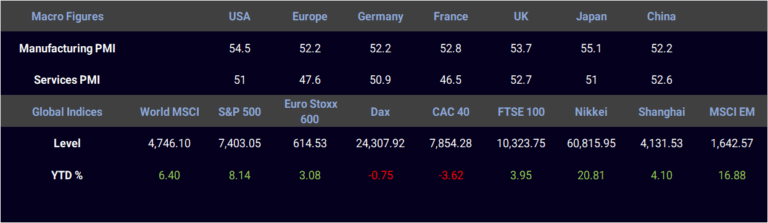
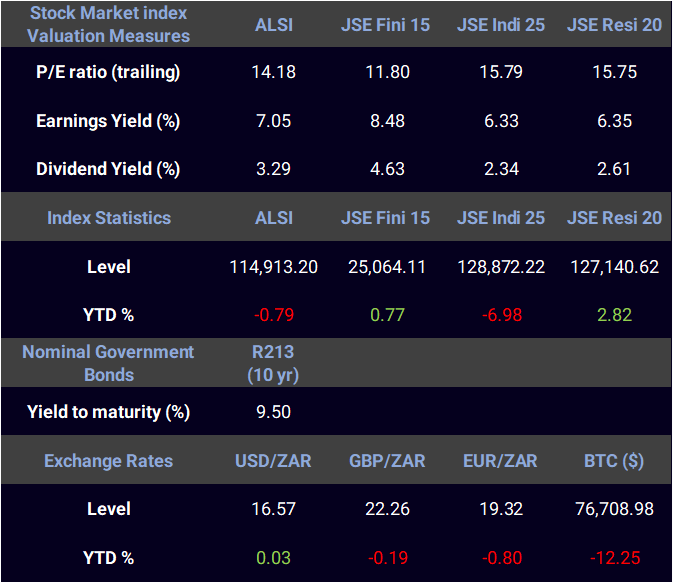
Reference: Capital Economics – Historical bond and equity return data.
Invest Today
Spend some time with our team to find out which one of our portfolios is best for you!
