
Global Report
How long can the investment cycle continue?
Learn more
Local Report
Promising GDP reading, but we aren’t out of the woods yet.
Learn more
Market Indicators
Global and local indicators.
Learn more
Global Report: How long can the investment cycle continue?
By Nick Downing
The global investment cycle is one of the longest and most powerful in modern financial history. Measured by the global stock/bond ratio — the most reliable barometer of the cycle’s direction — the current “Higher-Conviction Rally” phase is now 186 weeks old and has delivered total gains of 85%. Bull markets do not die of old age: they end when specific catalysts force investors to reprice risk. The critical question today is whether any such catalyst is imminent. Fortunately, not yet — but the risks are building and the easy money has been made.
The framework we use identifies eight phases in the global stock/bond cycle. We are firmly in Phase 5, characterised by broadening economic expansion, rising corporate profitability and strong equity outperformance relative to bonds. The hallmarks are well in evidence. The S&P 500 has reported first-quarter 2026 earnings growth of 28%, year-on-year on revenue growth of 11%, the US economy continues to expand, and the equity rally seems unstoppable. By conventional metrics, the bull market remains very much intact. But what comes next, are the bear market phases 6-8, which end the investment cycle.
History tells us that bear markets are almost always preceded by economic recessions, and recessions need a catalyst. Four potential triggers are worth monitoring: a destabilising bond market shock from sharply higher yields; a policy shock that damages corporate confidence or profitability; pre-emptive investor de-risking in the face of stretched valuations and tightening liquidity; or the deflation of an AI-driven technology bubble. None has yet materialised with sufficient force to derail the cycle — but the trajectory is concerning on more than one front.
The most immediate structural threat comes from the bond market. The US 30-year Treasury yield has reached a 19-year high of 5.18%, and the Federal Reserve’s April FOMC minutes revealed a hawkish U-turn, signalling that the rate cutting cycle is over. The core problem is structural: the developed world is more inflationary than at any time since the 1980s, with inflation running above its 2000–2020 average in all major economies. Governments are simultaneously running large fiscal deficits during an economic expansion — precisely the wrong moment — and bond markets are only beginning to demand compensation for this policy error. A sharp, disorderly rise in yields could rapidly tighten financial conditions and terminate the cycle.
Complicating the picture is a geopolitical wildcard of the first order. Whilst there is a peace deal between the US and Iran, the Strait of Hormuz crisis — through which approximately 20% of global oil trade passes — has introduced an energy shock that could amplify inflation and suppress growth simultaneously. Gasoline prices are up sharply, eating into household disposable income and affecting consumer confidence. Energy shocks of this magnitude have historically been the main cause of some of the most severe bear markets of the post-war era, and this one is not yet entirely resolved.
Valuations add a further reason for caution. The long bull market has inflated asset prices across multiple categories simultaneously: US secular growth stocks, AI-related equities, Bitcoin, gold and real estate all trade at or near historically elevated levels. The concentration of gains in a narrow cohort of mega-cap technology stocks has created a fragility that mirrors past bubble episodes. What makes this cycle particularly demanding is the dearth of attractively priced assets. Investors seeking safety face the uncomfortable reality that traditional refuges — bonds, defensive equities, real assets — offer little margin of error.
Against these risks stands a structural pillar that has supported markets through every setback of the past decade: the “buy the dip” conditioning of a generation of investors. Multiple rounds of central bank intervention between 2010 and 2020 taught markets that policy makers will always backstop risk assets. This conditioning is deeply embedded in investor behaviour and has repeatedly arrested market declines before they could develop into full bear markets. So long as corporate earnings continue to beat expectations — and they have done so with remarkable consistency — and the global economy avoids recession, the reflexive bid for equities during dips is likely to remain powerful.
The most significant portfolio implication of late-cycle dynamics is the ongoing rotation away from US mega-cap growth toward non-US markets and more diversified sector exposures. Euro area, emerging market and Japanese equities offer better relative valuations and are earlier in their respective cycles. Within the US, the evidence increasingly favours a barbell approach: industrials, financials and healthcare on one side; broad, equally weighted S&P 500 exposure on the other. The era of simply owning the US large-cap growth index and outperforming the world appears to be giving way to a more nuanced, geographically diversified posture. Capital is rotating, and investors who ignore this rotation risk significant relative underperformance.
How much longer can the cycle run? The fundamentals support continuation over a 6- to 12-month horizon, assuming the Strait of Hormuz crisis continues to de-escalate and bond yields rise gradually rather than disruptively. But the window of clear upside is narrowing. The risk asymmetry — modest additional gains against the prospect of a sharp, potentially rapid reversal — suggests that investors should be steadily reducing position sizes in extended assets, diversifying geographically, and maintaining higher-than-usual liquidity buffers. This is not the moment for maximum risk-taking; it is a moment for active management of downside exposure.
The investment cycle is mature but not exhausted. There is no obvious, imminent recession catalyst — but there are multiple realistic pathways to one, and several are becoming more plausible by the month. The bond market is the key variable to monitor. Should yields rise sharply and disorderly from already-elevated levels, the cycle could end faster than most expect. In this environment, capital preservation matters as much as return generation. Investors should continue to participate in risk assets while actively managing downside — prioritising quality, diversification and balance sheet strength over pure growth. The final chapters of a long bull market can still be rewarding, but they demand restraint.
Local Report: Promising GDP reading, but we aren’t out of the woods yet
By Sean Fitzpatrick
The most important local economic release over the past month was undoubtedly South Africa’s first quarter GDP figure. The economy expanded by 0.5% quarter-on-quarter, marking a sixth consecutive quarter of positive growth. On the surface that may not sound too exciting, especially in a country that requires significantly higher growth rates to address unemployment and improve living standards, but in our view the result is nevertheless encouraging because it reinforces a trend that has gradually been developing over the past two years.
What makes the latest GDP number interesting is that growth was reasonably broad-based (i.e. it was not concentrated). Financial services once again made a meaningful contribution, continuing a trend that has persisted for several quarters. Agriculture also remained a bright spot, benefitting from favourable production conditions and contributing positively to economic activity for a sixth consecutive quarter. Trade, transport and communication services all added to growth as well, suggesting that parts of the economy continue to demonstrate resilience despite the numerous structural challenges that businesses still face on a daily basis.
The manufacturing sector remains the obvious weak point. While Eskom’s improved performance has removed one of the major constraints on industrial activity, manufacturers continue to battle logistics inefficiencies, rail bottlenecks and subdued demand conditions. Certain sectors are beginning to show genuine signs of recovery, while others remain constrained by issues that have been discussed for so long that they have almost become accepted as part of the operating environment.
Nevertheless, we believe investors should focus less on the absolute level of growth and more on the direction in which the economy is travelling. For much of the previous decade, economic data releases consistently disappointed expectations. More recently, the trend has started to shift. Growth remains modest, but it is becoming more consistent. Fiscal metrics are improving, load shedding has largely receded from daily conversation and although business confidence remains fragile, it is largely due to external factors.
The inflation picture, even with the latest elevated CPI reading of 4%, also remains relatively constructive. Headline inflation has remained contained and continues to compare favourably against many developed economies. This has provided the South African Reserve Bank with greater flexibility than many market participants would have expected two years ago. The benefit of lower inflation extends well beyond consumers. It improves confidence, reduces uncertainty around future costs and supports investment decisions by both households and businesses.
That being said, inflation risks have certainly not disappeared. The primary concern remains the oil price. Recent activity in the Middle East reminded investors just how quickly geopolitical events can affect global energy markets, either negatively or positively. This was evident in the uptick we saw on Monday this week, with the JSE ALSI gaining 2.5% on the back of a ‘tentative peace agreement’ between the US and Iran. While ceasefire discussions and diplomatic engagement have helped reduce immediate fears of a further supply disruption, the situation remains uncertain. South Africa imports the vast majority of its oil and is therefore particularly exposed to sustained increases in global energy prices. For that reason, we suspect the SARB will continue to adopt a cautious approach when considering future interest rate decisions. Although inflation has behaved to a certain degree, policymakers are unlikely to become overly confident while geopolitical risks remain elevated and global inflation remains a bit of a coin toss. The debate may therefore shift away from whether rates should rise and more towards how long rates may need to remain at current levels.
Perhaps the most encouraging development from a sovereign debt perspective has been the change in attitude from international credit rating agencies. Earlier this month Fitch upgraded South Africa’s sovereign credit rating from BB- to BB, while Moody’s revised its outlook from stable to positive. These decisions were driven largely by improvements in fiscal management, stronger revenue collection and evidence that government debt levels are becoming more stable than many analysts previously anticipated. Credit rating upgrades rarely dominate newspaper headlines, but they matter. Improved ratings reduce borrowing costs, attract foreign capital and signal increasing confidence in the country’s fiscal trajectory. Importantly, they also provide external validation that progress is being made in areas where investors have demanded improvement for a long time.
Of course, South Africa does not operate in isolation. Developments in the United States, China, Europe and the Middle East continue to influence capital flows, commodity prices and investor sentiment toward emerging markets. We continue to monitor these factors closely, particularly the evolving geopolitical landscape and the possibility that higher energy prices could reignite inflationary pressures globally.
Overall, we believe the latest GDP figures reinforce a narrative that has been quietly developing for some time. South Africa is not experiencing an economic boom, nor should investors expect one in the immediate future. However, when viewed alongside improving fiscal metrics, relatively contained inflation, greater energy stability and increasingly supportive commentary from international rating agencies, the broader picture appears considerably more encouraging than it did only a few years ago. For long-term investors, that gradual improvement in the underlying fundamentals is arguably more important than any single quarterly GDP release.
Market Indicators
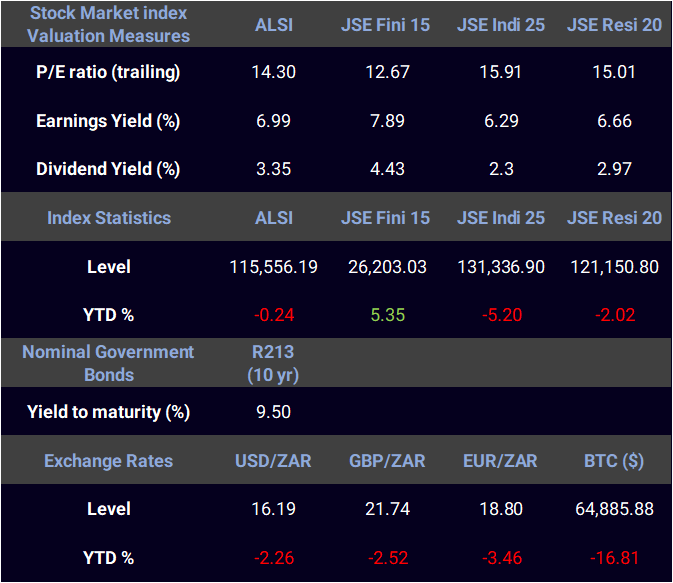
Make use of the many indicators below simply by clicking on each of the dropdown menus provided

Reference: Capital Economics – Historical bond and equity return data.
Invest Today
Spend some time with our team to find out which one of our portfolios is best for you!
