
Global Report
Global Market Review and Strategy Outlook for the quarter ended June 2026.
Learn more
Local Report
Local Market Review and Strategy Outlook for the quarter ended June 2026.
Learn more
Market Indicators
Global and Local Indicators.
Learn more
Global Report: Global Market Review and Strategy Outlook for the quarter ended June 2026
By Nick Downing
The second quarter (Q2) delivered one of the most powerful equity rebounds of the century, as the resolution of the US-Iran conflict removed the shock that had derailed markets late in Q1. Just as we anticipated, a ceasefire and the reopening of the Strait of Hormuz sent oil sharply lower and risk assets sharply higher. Brent crude, which had spiked to $118 per barrel at the end of Q1, fell back to $73 by the end of Q2, erasing the war premium to end below its pre-war level of $74. With the energy shock fading as quickly as it arrived, the underlying strength of the global expansion – broadening growth, robust earnings and an accelerating artificial intelligence (AI) investment boom – reasserted itself, carrying several major indices to record highs. The episode again showed that geopolitical shocks unaccompanied by fundamental deterioration tend to be buying opportunities rather than the start of bear markets.
The US led the recovery in Q2. The S&P 500 surged 14.9%, its best quarter since 2020, while the Nasdaq posted its strongest quarter in six years, driven by a 15.7% gain in April alone. The Philadelphia Semiconductor index rocketed 87.8% higher, its best quarter since inception in 1994, as demand for memory and AI chips overwhelmed all else. The rally also broadened: the Russell 2000 rebounded more than 26% from its April low, and equal-weight, value and micro-cap benchmarks set fresh record highs. Gains elsewhere were more measured. The UK’s FTSE 100 rose 3.2%, helped by its defence, banking and mining constituents, for its best run of consecutive quarterly gains since 2022, while Germany’s Dax recovered its first-quarter losses with a 10.2% advance. Japan’s Nikkei 225 reached a record high 70,062, capping one of its strongest quarters on record in local terms, with a gain of 37.2%, although a weaker yen trimmed the dollar return. China’s CSI 300 returned 11.9%, although it lagged compared with Far East emerging markets, held back by rotation into North Asian chipmakers and continued property weakness. The MSCI All Country World index (dollar-based) rose 14.5%, more than reversing its first-quarter fall, and the MSCI Emerging Market index (dollar-based) gained 23.3%, led by a surge in Taiwan and South Korea. The S&P Global Developed Sovereign Ex-US Bond index, also dollar-based, gained just 0.3% as a firmer dollar late in the quarter eroded returns. The US dollar index rebounded after the June policy meeting, breaking above 100 to its highest since May 2025, with a 1.2% increase in Q2, while the US 10-year Treasury yield rose from 4.31% at end-March to 4.42% at end-June.
The larger story is the durability of the global expansion. The International Monetary Fund forecasts world growth of 3.1% in 2026 – a modest slowdown, but solid given the shocks absorbed – and assumed geopolitical disruption would fade by mid-year, which the swift de-escalation has vindicated. Growth is also broadening beyond the US. Global purchasing managers’ indices softened during the conflict but falling energy prices and easy monetary settings and fiscal support should rebuild momentum into the second half. This broadening of both activity and market leadership is the defining feature of the cycle and lends the expansion a firmer footing than the narrow, US-centric advance of a year ago.
The US nonetheless remained the engine of global growth and the centre of the earnings recovery. With second-quarter reporting approaching, consensus S&P 500 earnings growth has been revised up to 23.1% year-on-year, from 18.8% at end-March, and revenue growth to 12.3%, the strongest since 2022, implying further margin expansion. The advance is also broad, with nine of eleven sectors showing an expected acceleration in earnings growth. Resilient consumer demand, business investment and the fiscal impulse of the One Big Beautiful Bill Act have sustained activity, even as earlier energy-price gains left their mark on inflation.
In Europe, the feared energy blow proved short-lived. Eurozone inflation eased to 2.8% in June, from 3.2% in May, as the price of crude retreated. The European Central Bank hiked its benchmark interest rate by 25 basis points in June, as expected, but further tightening is unlikely, keeping monetary policy accommodative. Germany’s fiscal reawakening continues to underpin the recovery. Having scrapped its constitutional ‘debt brake’, Berlin’s programme of defence and infrastructure spending should add around half a percentage point to growth and spill over to its trading partners. Eurozone growth of roughly 1% in 2026 looks pedestrian beside the US, but improves markedly on recent stagnation, with stimulative monetary and fiscal policy and cheaper energy tilting risks to the upside.
Asia and the emerging world diverged sharply. Japan’s growth will likely stay below 1%, but its mix is improving: rising real wages and is reviving consumer spending, emboldening the Bank of Japan to lift its policy rate and begin scaling back bond purchases after decades of ultra-loose policy. China still labours under a property downturn and weak sentiment, with growth slowing towards 4.5%; front-loaded fiscal measures, extended trade-in subsidies and cuts to rates and reserve requirements have stabilised activity more than revived it. India remains the standout, on track for 6.5% growth on strong domestic demand and manufacturing investment. Across emerging markets, fortunes now hinge on technology – Taiwan and South Korea soared on the AI boom while domestically-oriented economies lagged – but consensus earnings growth is the highest of any region.
The quarter’s most consequential shift came in US monetary policy. The Federal Reserve, now chaired by Kevin Warsh after Jerome Powell’s term expired in May, struck an unexpectedly hawkish tone at its inaugural meeting in June. Markets that began the year expecting further easing now price some 30-50 basis points of increases by year-end – in contrast to the ECB’s more cautious bias, the Bank of Japan’s gradual normalisation, and the People’s Bank of China, which alone is loosening in earnest to fight deflation. Inflation, the chief threat to the goldilocks mix of solid growth and easy policy, is again to the fore, and the bond market is its transmission channel. Core PCE, the Fed’s preferred inflation gauge, rose for a third consecutive month to 3.4% in May, well above the 2% target. The oil-price reversal should ease some pressure, but sticky underlying inflation reflects the late-cycle bind in which robust demand, scarce spare capacity and tight labour markets feed prices as much as activity. The 10-year Treasury yield rose to 4.42% and the Fed’s hawkish signal flattened the curve, narrowing the two-to-ten-year spread to its slimmest since March 2025. Higher yields have so far been absorbed by an earnings-driven market, but a decisive break to new cycle highs would reprice financial assets and compress valuation multiples far more seriously than any geopolitical flashpoint.
The other principal risk lies in the very sector leading the market. The vertical ascent of semiconductor shares and the concentration of returns in AI related stocks carry clear echoes of past technological exuberance, and with the S&P 500 on a forward multiple near 20 times – above its five- and ten-year averages – the market has priced in much good news. Given the US’ roughly two-thirds weight in global indices, and technology’s outsized share within it, any disappointment in AI monetisation or capital spending would be felt worldwide. Policy error is another danger: the Fed transition places its credibility and independence under scrutiny, while high public debt and fiscal-sustainability doubts leave little room for missteps before a watchful bond market.
Yet economists tend to caution, and bull markets climb a wall of worry. The upside equity market risks merit equal weight. The broadening of both the rally and the expansion beyond the mega-cap leaders places the market advance on wider foundations than a year ago. The AI investment cycle may still be in its early innings, its productivity gains yet to spread across industries and geographies; a replay of the late-1990s boom would imply meaningful further upside. Cheaper oil, double-digit earnings growth across most regions and still-expansionary PMIs all point to a durable expansion. We continue to see 2027, rather than 2026, as the more likely year for tighter policy and stretched valuations to catch up with markets. For now, with inflation the variable to watch and the 10-year yield its best barometer, we remain constructively positioned, mindful that the quarter’s exuberance leaves less room for error than existed at the depths of the first.
Local Report: Local Market Review and Strategy Outlook for the quarter ended June 2026
By Sean Fitzpatrick
The second quarter (Q2) of 2026 was defined by a single event that reverberated through every corner of the local market…the eruption of open conflict between the United States, Israel and Iran, and the resulting scramble to price a genuine threat to shipping through the Strait of Hormuz. Brent crude spiked from an average of $73.83 a barrel in the first quarter to $98.30 in Q2, and South African assets absorbed the shock unevenly. The JSE All Share Index fell 2.36% in Q2, extending its year-to-date decline to 2.96% by 30 June, even as the rand and local bonds staged a notable recovery once the worst-case scenario failed to materialise.
The headline number masked a sharp divergence beneath the surface. The Resources 10 index collapsed 19.69% in Q2, its worst quarterly showing in years, taking its year-to-date decline to 13.95% as miners bore the brunt of weaker commodity prices and heightened risk aversion. Financials told the opposite story, with the Financial 15 index gaining 8.20% in the quarter and 7.88% year to date, buoyed first by expectations of a rate hike and then by the South African Reserve Bank’s (SARB’s) actual move in May, both of which support bank margins over time. Industrials added 4.22% in Q2 but remain down 4.88% for the year, a reminder of how uneven the recovery across sectors has been.
Currency and bond markets defied the conventional playbook for a Middle East shock. The rand strengthened 3.25% against the US dollar to close the quarter at R16.39, and gained 3.02% against sterling, helped along by two credit-rating actions and diplomatic progress toward a ceasefire in the Middle East. Local bonds enjoyed an even stronger quarter, with the All Bond 1-3 Year Total Return Index returning 7.87%, as the 10-year government bond yield calmed from an early-quarter high near 8.77% in May to around 8.4% by early July, having spiked intermittently whenever Middle East tensions flared.
Structurally, South Africa’s reform and fiscal narrative continued to improve even as geopolitics dominated the headlines. Fitch upgraded the sovereign credit rating a full notch, from BB- to BB, and Moody’s revised its outlook from stable to positive while affirming the Ba2 rating, both citing steadier fiscal management, stronger revenue collection and a more credible debt trajectory. Eskom’s improved operational performance has removed one of the economy’s most persistent constraints, and although political noise around the Government of National Unity has not disappeared, it has so far failed to derail the underlying reform momentum that markets have been rewarding.
Growth data provided further support to that narrative. South Africa’s economy expanded 0.5% quarter-on-quarter and 1.9% year-on-year in the first quarter of 2026, the sixth consecutive quarter of positive growth and an acceleration from the 0.4% QoQ, 0.8% YoY pace recorded in the final quarter of 2025. Crucially, the expansion was broad-based rather than concentrated – agriculture grew 3.9%, finance 0.9%, trade and transport both 0.7%, and mining 0.7%, offsetting a soft manufacturing sector in which five of ten sub-sectors contracted. Private sector credit extension held up at close to 8.6% year-on-year and M3 money supply growth accelerated to just over 10%, both consistent with a private sector still willing to borrow and spend despite the more hawkish rate backdrop.
Sentiment indicators told a more cautious story than the hard data. RMB/BER Business Confidence dropped sharply from 47 in the first quarter to 39 in Q2, and the FNB/BER Consumer Confidence Index deteriorated from -7 to -19 over the same period, both reflecting the squeeze from higher fuel prices and the prospect of higher borrowing costs. The SACCI Business Confidence Index eased to 124.1 in May from 131.3 in March, continuing its slide from December’s 133.2. The Absa Purchasing Managers’ Index (PMI) captured the quarter’s arc precisely. Having jumped to 52.6 in April as manufacturers pulled orders forward ahead of expected cost increases, it slipped to 50.8 in May and fell further to 47.3 in June as that front-loaded demand faded, while the S&P Global/Standard Bank PMI held at a steadier 50.5 in June.
The inflation and policy story was the quarter’s central drama. Headline CPI jumped from 3.1% in March to 4.0% in April and 4.5% in May, driven almost entirely by a more than 15% single-month spike in petrol prices, while core inflation rose more gradually from 3.2% to 3.8% over the same period. On 29 May the SARB’s Monetary Policy Committee responded with a 25-basis-point hike, lifting the repo rate to 7.00% and the prime lending rate to 10.5%, in a split 4-2 decision that ended what had looked like an ongoing easing cycle. The Bank’s own Quarterly Projection Model still sees headline inflation averaging 4.4% for 2026 before moderating to 3.7% in 2027, and while consensus has pushed the next possible rate cut out to the first quarter of 2027, some house forecasts see scope for the May hike to be reversed as soon as November this year should oil prices continue to normalise.
The risk to that disinflation path remains squarely geopolitical rather than domestic. A further 25-basis-point hike at the July MPC meeting has not been ruled out should the Middle East ceasefire prove fragile, oil prices stay elevated, or the rand come under renewed pressure. The more encouraging signal, however, is that reform credibility is being rebuilt from a low base: two ratings actions within a month, continued progress at Eskom, and a private sector still extending credit at close to double-digit rates all point to a foundation that can absorb a temporary external shock without derailing the broader recovery.
For all the quarter’s volatility, the underlying earnings picture at company level has, if anything, improved. Several of our portfolio holdings reported double-digit revenue and earnings growth over the period, evidence that the operating environment, helped by more stable power supply and gradually improving business conditions, continues to outpace the gloomier tone of the confidence surveys. We expect the SARB to hold rates through the second half of the year unless the oil shock re-escalates, for the rand’s resilience to persist as ratings momentum builds, and for South African equities to grind higher over the next twelve months as the reform and ratings narrative reasserts itself over the current period of geopolitically driven noise.
Market Indicators
Make use of the many indicators below simply by clicking on each of the dropdown menus provided
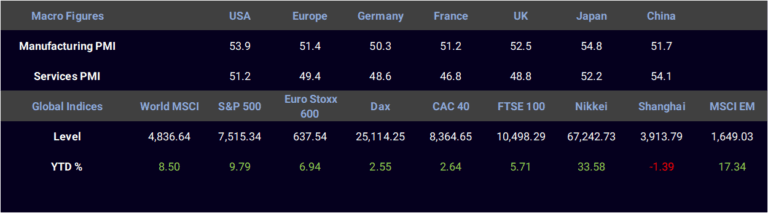
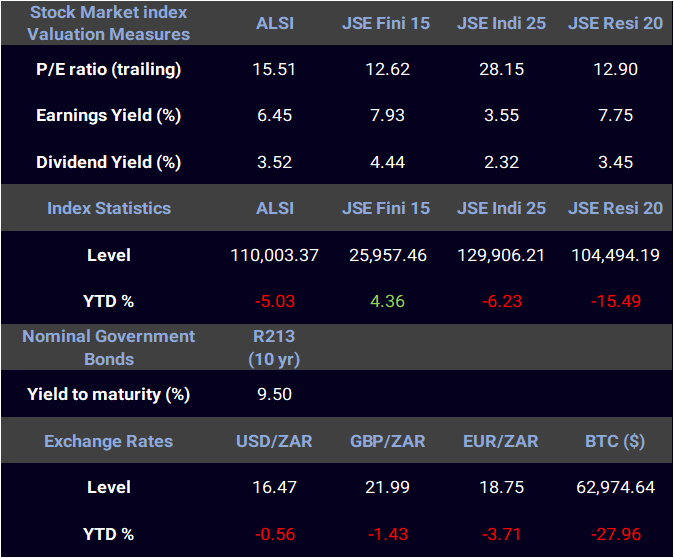
Reference: Capital Economics – Historical bond and equity return data.
The Bottom Line: Innovation and the Magic of Compounding
By Carel La Cock
The oldest investment trust listed on the London Stock Exchange can trace its beginnings back to the surging demand for rubber at the advent of the car industry. Following the Panic of 1907 when the New York Stock Exchange fell nearly 50% from its peak, credit markets dried up and realising the opportunity to lend to rubber plantations in Asia, Colonel Augustus Baillie and Carlyle Gifford established The Straits Mortgage and Trust Company Limited that would ultimately become the behemoth: Scottish Mortgage Investment Trust (SMT), a constituent of the FTSE100.
Baillie Gifford & Co, the investment management company that stewards SMT, oversee total assets in the fund of £16.67bn as at the end of February 2022. Outgoing manager, James Anderson, defined his career with early investments in Amazon and Tesla, which propelled the fund to cumulative growth of 696.8% in the last 10-years, compared to 220.4% for its benchmark, the FTSE All-World Index. Anderson’s investment philosophy has always been based on the belief that technological improvements will drive innovation and that even picking a small number of these successful future companies and holding on to them long enough to let the magic of compounding work, will lead to exceptional returns for clients. Tom Slater, co-manager since 2015, will take over the reins at the end of April and believes that it matters less failing to sell the holdings you should sell, than selling the holdings you should not sell. When they go long on investments, they remain long offering support as patient investors often nurturing private holdings until they go public.
After a stellar performance in 2020 which saw net asset value (NAV) grow by 106.5%, 2021 was more subdued by its own standards, up only 13.2%. This year the share price has come under severe pressure from rising inflation and the rising interest rate used in discounting long duration income flows on many of the growth stocks in its portfolio. Moderna, the manufacturer of Covid-19 vaccines and the largest holding in the portfolio at 8% is down nearly a third year to date, while Tencent, the Chinese e-commerce giant, at 4% of the portfolio is down nearly a fifth this year. Others in the top five holdings: ASML (-13%), Illumina (-9.6%), Tesla (-13%) and NVIDIA (-10.4%) have all been downgraded due to expectations of a steepening yield curve.
Is now the time to panic and if not now, then when? Geopolitical risk is at an all-time high, the US federal reserve has just hiked interest rates for the first time since 2018 and global inflation is running rampant while oil and gas prices have spike on supply fears. However, listening to manager, Tom Slater and deputy manager, Lawrence Burns discuss the current environment and the outlook for the portfolio in a recent investor presentation, you don’t get the sense that now is the time to panic, or indeed ever. Their strategy is long-term, and they have positioned the fund to participate in structural changes and technological advances in society. They have incredible deal flow built on decades of strong relationships and a reputation for stability and patience. Entrepreneurs are keeping companies private for longer and having early access to investment in these opportunities often leads to extraordinary returns.
As for its current top holding, asked if Moderna is a “one-trick-pony” with reference to the major windfall from the Covid19 vaccine, but recently downgraded as investors see the end of the pandemic and the Covid-19 vaccine franchise, Lawrence answered “Moderna is a one trick pony, but that one trick is a broad and important one and that trick is mRNA.” The biotechnology behind the Covid-19 vaccine is a powerful one with programmes to cure zika, HIV, cancer and a range of other ailments making the recent windfall unlikely to be a once-off.
Regarding the tightening of regulation in the Chinese technology sector and its impact on Tencent, the team thinks that the Chinese government is ahead of the curve in terms of regulation and that democratic western nations will eventually implement similar regulatory changes. They believe that companies that “go with the grain of society” and who are aware of their broader impact on society will find it easier to prosper. In this regard, Chinese tech companies are further along the route of enlightenment.
Lastly, Tom Slater does not agree that higher inflation and rising interest rates should lead to lower valuations on growth stocks. He cautions investors to also consider the impact of pricing power on some of these high growth companies as they become market leaders in their field. Therefore, with higher expected future inflation, one should also adjust the future cash flows that will yield a better current valuation. Looking past the current volatility, the fund has invested in some ground-breaking technology and the managers are excited by the intersection of computing power and biology calling the opportunity set “large and varied” They have 49 investments in private companies, and it is not difficult to imagine the next Amazon and Tesla coming from that pool.
Invest Today
Spend some time with our team to find out which one of our portfolios is best for you!
