
Global Report
Earnings do the heavy lifting.
Learn more
Local Report
Your home is South Africa. Can your wealth be somewhere else?
Learn more
Market Indicators
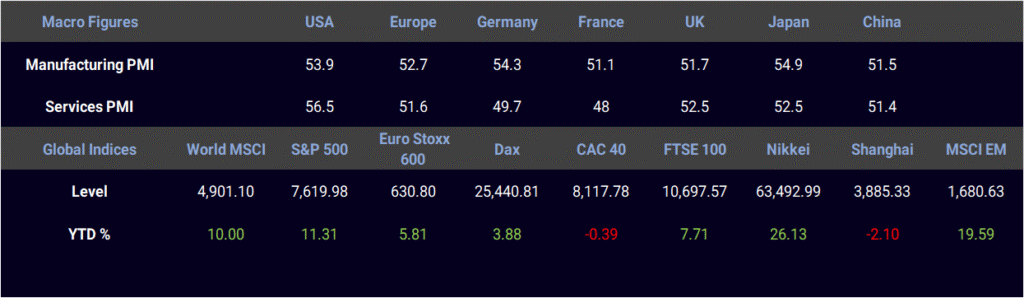
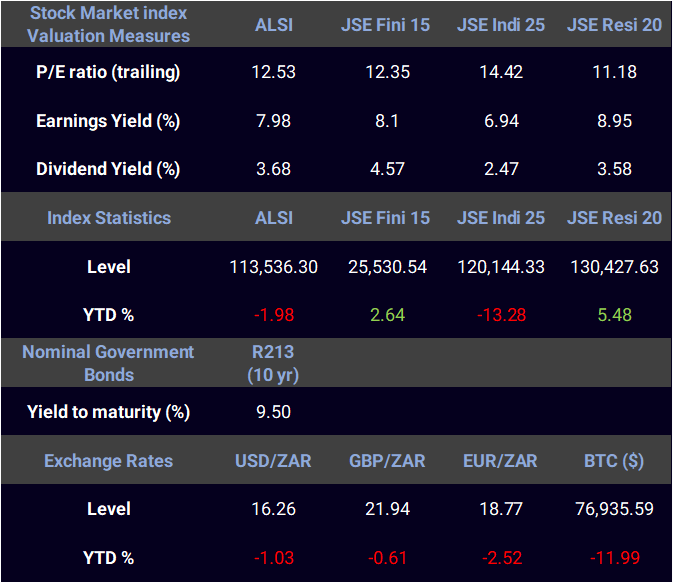
Global and local indicators.
Learn more
Global Report: Earnings do the heavy lifting
By Nick Downing
Global equity markets have spent 2026 climbing from one record high to the next — the S&P 500 has set more than two dozen of them and is up around 11% for the year — and yet, for all the talk of stretched valuations, share prices have risen far more slowly than the profits supporting them. That is an unusual state of affairs, and, we would argue, an encouraging one. A market that makes new highs while its earnings grow faster still is not becoming more expensive; it is becoming better supported. The gap between what companies are earning and what investors are willing to pay for those earnings has, if anything, been closing.
The scale of the earnings expansion has been extraordinary. According to LSEG I/B/E/S data compiled by MRB Partners, S&P 500 companies grew second-quarter earnings by 52% year-on-year, on revenue growth of more than 15%. This is the strongest pace since the recovery from the pandemic and the seventh consecutive quarter of double-digit growth. Even after stripping out the mark-to-market gains that flattered the headline number, chiefly the large unrealised profits on the stakes Alphabet and Amazon hold in Anthropic and SpaceX, underlying growth was still close to 30%. More than 85% of companies beat earnings estimates, profit margins reached a record, and consensus now expects earnings to rise 33% across 2026 as a whole, followed by 15% in each of the next two years. Earnings growth has, quite simply, exploded.
Because profits have outrun prices, valuations have quietly de-rated even as the index has made new highs. The S&P 500 began the year on a forward price-earnings multiple of around 22 times — one of its richest readings on record — and that multiple has since slipped back as earnings caught up with, and then overtook, the share-price gains. Capital Economics made the point neatly in a note on 27th August: big-tech companies’ share prices, it observed, have “grown much more slowly than their earnings have”, and the sector’s valuation premium “has narrowed further”. MRB Partners, in its 4th September asset-allocation review, went further, arguing that “better value and improving growth momentum” now justify overweighting select markets outside the United States. Valuations, in other words, are beginning to look compelling rather than dangerous.
Nowhere is this de-rating more evident than in the very part of the market that has attracted the most anxiety, notably AI. Artificial intelligence remains the driving force behind a deepening and broadening of global growth — the capital spending on data centres, semiconductors and power generation is now the single largest swing factor in the United States economy — and yet the shares most exposed to it have lagged. Capital Economics notes that the ten most profitable companies in the S&P 500, which between them account for roughly a third of the index’s earnings, would actually have underperformed the market this year. The engine of the expansion has been re-rated downwards even as it does the heavy lifting.
That the market disbelieved the AI investment case is not in doubt: through the first half of the year, credit-default-swap spreads on the hyperscalers widened and their multiples compressed to their worst stretch of relative performance since 2022. The second-quarter results allayed the concerns. BCA Research, in its strategy note of 3rd August, showed that the return on incremental invested capital for the hyperscalers is running near 30%, with cloud revenues up 43%, and concluded plainly that “the ROI on AI capex is showing up”. In a companion piece the following day, BCA’s Marko Papic argued that, with the AI concerns now largely addressed, “only the Ayatollah and Putin can save the bears” — that only a genuine geopolitical shock, rather than anything in the fundamentals, could derail the advance. Crucially, technology’s forward earnings multiple has fallen relative to the start of the AI boom, relative to the rest of the market, and relative to the dotcom peak of 2000: the sector’s equity risk premium is a positive figure of around 2% today, against roughly minus 2% at that earlier summit. The excess that ended the last cycle is simply not present in this one.
As always there are significant risks, of which two stand out: a rapid rise in long-term bond yields, and a fresh bout of geopolitical turbulence. The bond-market case deserves to be put fairly. MRB warns that global yields are “poised to climb further over the next 6-12 months”, with central banks possibly needing to tighten by more than investors expect, and with the enormous capital demands of the AI build-out — alongside heavy government borrowing — adding to the upward pressure. The US 10-year Treasury yield, hovering at 5.0%, is already at its highest since October 2023, and a Federal Reserve under more hawkish leadership could lift the policy rate by 75 basis points according to fed funds futures. Against that, Capital Economics doubts the Treasury market will “be the straw that breaks the US stock market’s back”, noting that monetary policy is most unlikely to be tightened anything like as aggressively as it was into 2000. Two facts reinforce the calmer prognosis. Bond-market volatility, as measured by the MOVE index, remains muted, and inflation expectations well anchored. And monetary conditions are still, on balance, accommodative: with both the policy rate and the 10-year yield sitting below nominal GDP growth of around 5%, and far below the pace of earnings, the cost of capital remains comfortably beneath the return on capital.
The geopolitical risk is, for now, chiefly an energy risk. Brent crude has climbed back above $100 a barrel — most recently on attacks against Saudi facilities — and stands some 50% above its level of a year ago. Yet the world is coping with elevated oil prices far better than the headlines imply. MRB judges the current level “roughly neutral” for global growth, observing that today’s prices merely remove a previous tailwind rather than impose a fresh drag, and its earlier work on energy sensitivity cautioned against underestimating the economy’s resilience. With the US midterm elections in November, moreover, the administration has little appetite to let fuel prices run higher into the vote, and the incentives point firmly towards relief. We would expect oil to drift lower rather than spike from here.
It is worth adding that rising bond yields are not, in themselves, a threat. Part of the increase reflects rising productivity — US productivity growth is running well above its long-run norm enabling a higher potential growth rate for the economy; a bond market repricing to reflect stronger real growth and stronger earnings is a rational and healthy development, not a warning. In the end it is earnings, not multiples, that drive markets, and the earnings picture is strong enough that even a considerable disappointment could be absorbed while leaving the investment case intact — the forecasts carry a wide margin of error in the investor’s favour. Valuations are undemanding relative to where they have stood at comparable moments in the past, and the greater danger, as ever, lies in calling the bear market too early rather than in staying invested.
Overberg Asset Management therefore remains fully invested, holding to its long-standing tilt towards the technology leadership driving this cycle while diversifying steadily towards the better-value markets outside the United States. And where are we in that cycle? BCA’s work is instructive: technology capital spending has only just reached the levels, relative to the economy, that it attained in the 1990s, and grafting the current investment boom onto that earlier trajectory suggests it could run for another three to five years. If the 1990s are any guide, this bull market is closer to 1995 than to 2000 — and there is a great deal of road between the two.
Sources: MRB Partners (August–September 2026); Capital Economics (August–September 2026); BCA Research (August 2026); LSEG I/B/E/S.
Local Report: Your home is South Africa. Can your wealth be somewhere else?
By Sean Fitzpatrick
When I speak to family and friends about the idea of a portfolio, there is a natural connection between where we live and where we invest. We earn our salaries in rands, pay our expenses in rands and buy assets in South Africa. It is easy to assume that because our lives are tied to South Africa, our wealth should be too. Do we ever stop to ask the question: “Does that really have to be the case?”
South Africa’s latest GDP figures provide some insight. Our economy contracted by 0.2% in the second quarter of 2026, after growing by a revised 0.4% in Q1. On a year-on-year basis, the economy still grew 0.9%, but the latest figure highlights why the term ‘anaemic’ is widely used as the adjective when describing SA growth. However, there were some encouraging elements within the numbers. Household consumption increased by 0.4% during the quarter, while financial services and transport provided support. Unfortunately, mining contracted by 3.0% and manufacturing declined by 1.8%. These numbers are not particularly surprising in an economy that has spent years dealing with constraints around infrastructure, logistics, electricity and weak investment.
None of this means that South Africa is a poor place to invest. Just as one swallow does not make a summer, neither does a bad GDP reading make a recession. It does, however, raise a more interesting question: if South Africa represents such a small portion of the global economy, why should your investment portfolio be so heavily concentrated here?
There was a time when the answer was very much practical. International markets were difficult and expensive for ordinary South Africans to access. That type of access was reserved for the mega wealthy. Today, that is no longer the case. A South African investor can own a diversified portfolio of companies across the United States, Europe, Asia and emerging markets with little more effort than it takes to buy a share on the JSE. The world has effectively become a much smaller, and much more accessible investment market.
Take a step back and consider what that means in terms of your portfolio options. South Africa can be dealing with weak domestic demand while another economy is experiencing strong consumer spending. Our mining sector can be under pressure while global technology companies are benefiting from rapid investment in artificial intelligence. The rand can be weakening while foreign assets are appreciating in their own currencies. Owning a broader range of assets means that your financial future is not dependent on a single country’s economic fortunes.
The South African Reserve Bank’s latest monetary policy environment illustrates how different our domestic economic conditions can be from those elsewhere. The policy rate currently stands at 7.0%, with inflation at 4.3%. Investors in other parts of the world are operating with entirely different inflation, interest-rate, and economic-growth dynamics. A global portfolio, or local portfolio with global exposure, allows investors to participate in those different environments.
It also changes the way we think about what constitutes a South African investment. Some of the companies listed on the JSE have become genuinely global businesses. Their shares may trade in Johannesburg, but their customers, employees, assets and earnings can be spread across several continents. Buying an SA-listed company therefore does not necessarily mean making a purely South African economic bet. The reverse is also true. Buying an international company does not necessarily mean turning your back on South Africa. It simply gives you exposure to another part of the global economy.
This is an approach we have taken at Overberg Asset Management when constructing our local portfolios. They are not designed around a purely South African view of the world. Alongside carefully selected ‘SA Inc’ businesses, we incorporate companies with significant offshore operations as well as global ETFs, allowing investors to gain meaningful international exposure while remaining invested through a local portfolio. For clients who want their investments to be entirely offshore, an offshore portfolio provides that option as well. The distinction is therefore not simply between investing locally or going offshore, but rather how much global exposure is appropriate for each investor.
This distinction becomes particularly important for investors who are accumulating wealth over decades rather than months. Over a long investment horizon (eg. 10-15 years), the objective is not necessarily to predict which country will perform best next year, but rather to build a portfolio capable of participating in different sources of growth while limiting the damage when one market struggles or experiences a sell-off.
South Africa has plenty of potential sources of future growth. Improvements in electricity availability, infrastructure investment, logistics reform and greater private-sector participation could all contribute to a stronger domestic economy. There are also areas of the JSE where valuations can become particularly attractive precisely because sentiment towards South Africa is weak.
A global portfolio does not require abandoning these opportunities. In fact, the most sensible approach may be to stop thinking about the decision as South Africa versus offshore. It isn’t a binary choice. A South African investor can own local banks, retailers and miners while simultaneously owning global technology, consumer and industrial businesses. The balance can change as valuations and circumstances change. That is very different from simply moving money offshore because South Africa is having a difficult year.
The latest GDP number is only one data point. It does not tell us where the rand will be in five years, whether South Africa will accelerate its reform programme, or which businesses will create the most wealth for shareholders. Nor does it tell us whether global markets will continue to outperform. It does remind us, however, that our domestic economy is only one part of a much larger world.
For South Africans looking to build meaningful wealth, perhaps the question is no longer “Should I invest offshore?”. It is “How much of my financial future should depend on the country in which I happen to live?” There is something reassuring about being able to answer that question without having to make a choice between South Africa and the rest of the world. South Africa can remain your home, your community and the place where you build your life. Your wealth, however, can have a passport.
Market Indicators
Make use of the many indicators below simply by clicking on each of the dropdown menus provided
Reference: Capital Economics – Historical bond and equity return data.
Invest Today
Spend some time with our team to find out which one of our portfolios is best for you!
