
Global Report
Bond yields: a rising threat.
Learn more
Local Report
If it sounds too good to be true, it probably is.
Learn more
Market Indicators
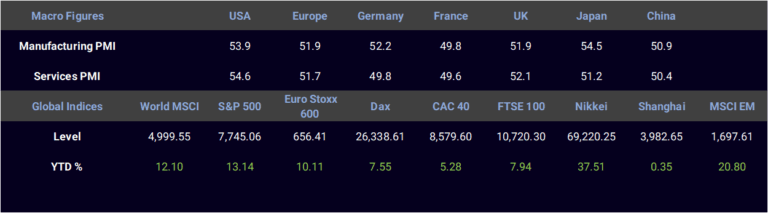
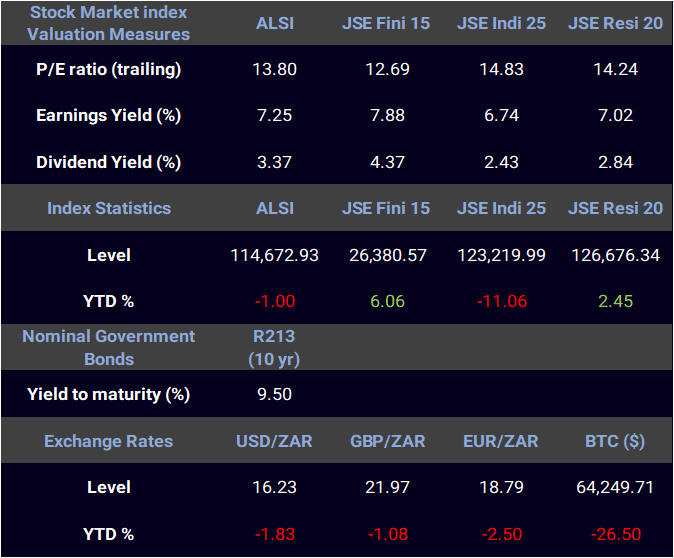
Global and local indicators.
Learn more
Global Report - Bond yields: a rising threat
By Nick Downing
The global equity bull market is one of the longest and most powerful in modern financial history, and the investment cycle supporting it shows little sign of fatigue. Growth is broadening rather than fading: the global composite purchasing managers’ index has edged further into expansionary territory, with both manufacturing and services contributing, and the world economy has absorbed this year’s energy shock with remarkable resilience. The International Monetary Fund expects global growth of around 3.1% in 2026. Above all, corporate earnings, the ultimate engine of share prices, remain robust, with consensus twelve-month forward earnings growth for global equities running at an extraordinary 33%. Bull markets, it is worth remembering, do not die of old age; they end when a specific catalyst forces investors to reprice risk. By most conventional measures the bull market remains very much intact.
But beneath this benign surface, one variable has quietly begun to work against the market. Government bond yields are rising, steadily and persistently. The G7 ten-year government bond yield has broken out of the three-year trading range that had contained it since 2023, and the climb has been relentless. In the US, the ten-year Treasury yield has risen by roughly 70 basis points since late February, while the thirty-year yield has pushed to a nineteen-year high. What makes the move notable is not its speed, which has been measured, but its direction and its breadth: yields are grinding higher across developed markets and across the maturity curve, at the very moment equity investors have grown most complacent.
Of all the risks to a continuation of the bull market, a destabilising rise in long-term bond yields is the single greatest. The mechanism operates through three reinforcing channels. First, higher yields lift the cost of capital across the economy, raising the hurdle rate for corporate investment and the cost of servicing debt. Second, they compress equity valuation multiples: the yield on a “risk-free” government bond is the discount rate against which all financial assets are valued, and as it rises the present value of future corporate profits falls, all else being equal. Third, and most powerfully, rising yields drain global liquidity, the oxygen that feeds asset markets. Every successive high in the US ten-year yield this decade has led to a meaningful equity de-rating, most painfully in 2022, when the S&P 500 fell by around 25% over ten months as yields marched towards 5%. The lesson is not that yields cannot rise, but that a disorderly rise is the classic terminator of bull markets.
Yields are being led higher by a confluence of forces, most of them a by-product of economic strength rather than weakness. Growth has been running well above trend, with private final sales to domestic purchasers in the US accelerating to a 3.9% annualised rate in the second quarter, from 1.7% in the first, and strong growth naturally lifts the equilibrium level of interest rates. Compounding this is an extraordinary thirst for investment capital: the artificial-intelligence capital-expenditure boom is absorbing savings on a colossal scale, with the backlog in cloud compute orders rising by another $250 billion in the past two months alone to $1.75 trillion. This thirst competes with governments and other borrowers for a finite pool of capital. Layered on top are stubborn inflation, discussed below, and a gradually rising term premium, the additional yield investors demand for holding long-dated bonds, as markets begin, belatedly, to require compensation for large fiscal deficits and an uncertain long-run inflation path.
Inflation is the biggest threat of all, and it is in the US, paradoxically the strongest of the major economies, that the threat is most acute. American inflation has now run above the Federal Reserve’s 2% target for five straight years, and core PCE inflation, the Fed’s preferred gauge, has recently reaccelerated to above 3%, catching a complacent central bank and consensus off-guard. Services inflation remains sticky, and the AI-capex boom is increasingly spilling into consumer prices. Whether inflation subsides from here or proves entrenched is now the single most important, and most fiercely debated, question in markets, because the answer determines the path of both policy rates and bond yields.
There is, in fairness, a credible optimistic case. For all its persistence, inflation over the past five years has been driven in large part by a succession of supply shocks: the pandemic, the 2022 oil shock, and the tariff and energy disruptions of 2025 and 2026, each of which the economy has ultimately absorbed. Labour markets are less tight than they were, wage pressures have eased, and the most recent data carry tentative signs of inflation rolling over. It is even possible that we are entering an era of productivity-led disinflation, in which the efficiency gains from artificial intelligence allow output to grow without a commensurate rise in prices; US non-financial-sector productivity is already growing at close to 2% a year, well above its long-run average. This, in essence, is the view held by the new Federal Reserve chair, Kevin Warsh, who believes the disinflationary forces are stronger than the consensus fears.
Central-bank policy is itself a decisive influence on where yields go next, and here the recent record inspires little confidence. Having been badly wrong-footed after the pandemic and the 2022 oil shock, when they mistakenly dismissed the inflationary surge as “transitory”, the major central banks have executed a U-turn towards tightening since the start of the year. The question is what the forward market is now discounting for the Fed. It may prove to be one-and-done, but the market’s reaction to July’s Federal Open Market Committee meeting was worrying: having held the policy rate at 3.5–3.75% despite three dissenting votes for a hike, the Fed watched the thirty-year Treasury yield jump to a nineteen-year high. Chair Warsh has argued that the bond market is “doing the heavy lifting” for the Fed, implying it need tighten by less; independent research firm MRB Partners counters, persuasively, that the logic is backwards, since most of the rise in yields reflects investors’ expectation that the Fed should be raising rates, and by declining to deliver the Fed risks losing its grip on the long end of the curve. A central bank that falls behind the curve may ultimately be forced into far more aggressive tightening to restore its credibility, the recipe for precisely the disorderly move in yields that markets most fear.
What level would the US ten-year yield need to rise to for serious damage to be inflicted on equity markets? Our view is that the danger zone lies somewhere around 5% to 5.5%, a level that would exceed the cycle peak of late 2023, when the ten-year briefly touched 5% for the first time in sixteen years. We are edging closer to that threshold, with the ten-year sitting in the 4.6-4.7% range, and the underlying trend is upward. This is the variable we are watching most closely, because in the absence of recessionary threats it has proved the most reliable early-warning signal of trouble ahead for risk assets.
If we are cautious on the direction of bond yields, how should that shape the construction of balanced portfolios, and the traditional 60:40 split between equities and bonds? The answer lies less in abandoning bonds than in changing their character. We favour short-duration bonds, in the one-to-three-year range, where prices are far less sensitive to a rise in long-term yields and which allow us to reinvest at progressively higher rates as they mature. This preserves the defensive ballast that fixed income is meant to provide, without exposing capital to the losses that a further rise in long yields would inflict on longer-dated bonds. On the equity side we remain invested, for bull markets climb a wall of worry and the greater risk is usually being out of the market than in it, but we continue to favour diversification away from the richly valued, heavily concentrated US mega-cap technology complex towards the more reasonably priced markets of the emerging economies, Japan and Europe. The bond market is sending a signal that warrants respect rather than alarm: the cycle can run further yet, but this is a moment for vigilance, for shorter duration, and for a close eye on the US ten-year yield.
Local Report: If it sounds too good to be true, it probably is
By Werner Erasmus and Sean Fitzpatrick
Investing has never been more accessible. With a smartphone and an internet connection, almost anyone can access financial markets, buy shares or cryptocurrency, and follow investment advice from people around the world. While this has clearly improved access to financial information, it has also created an entirely new challenge for investors: separating legitimate financial advice from sophisticated scams. This is especially relevant in a difficult economic environment, where many people are looking for ways to improve their financial position. The combination of financial pressure, social media, and the promise of making ‘a quick buck’ creates a prime opportunity for investment fraud.
On a daily basis, South Africans are exposed to Ponzi and pyramid schemes, fraudulent forex and cryptocurrency opportunities, automated trading bots and so-called “finfluencers” offering financial advice through platforms such as TikTok, Instagram, YouTube, and WhatsApp. Although these schemes can look vastly different, they often rely on the same human weaknesses – greed, FOMO, and the belief that there is an easier way to become wealthy.
How do these schemes work?
One of the oldest forms of investment fraud is the Ponzi scheme. The principle is simple. Investors are promised unusually high returns, but instead of generating those returns through a legitimate underlying investment, money from new investors is used to pay earlier investors. The scheme can appear to work extremely well in its early stages because investors may actually receive payments. Those investors then tell friends, family, and colleagues about the impressive returns they are earning, bringing more money into the scheme. Eventually, more investors are looking to withdraw their funds and the amount of money required to satisfy withdrawals becomes greater than the amount coming in from new investors, and the structure collapses. Think of it like a JoJo tank. If the tap on the bottom is open, the top constantly needs to be filling with rain for water to flow. Once it stops raining, and the tap remains open, the tank eventually runs dry.
Pyramid schemes operate on a similar principle, although recruitment is a central part of the model. Participants or ‘members’ are encouraged to recruit new members, who in turn recruit others, with the money from new participants supporting those higher up the structure. Once the pool of new participants is exhausted, the model becomes unsustainable.
A more modern version of the same promise can be found in supposedly sophisticated forex and cryptocurrency trading bots. These systems are often marketed using artificial intelligence and algorithmic trading terminology, with claims that the software can generate extraordinary or even consistent returns. The obvious question is “if someone genuinely possessed an algorithm capable of generating abnormal, repeatable returns, why would they need to sell it to the public?”
There is also a more fundamental problem. Trading strategies tend to work under specific market conditions, and when those conditions change, the strategy may no longer perform as expected. A bot that produces impressive returns during a favourable period can therefore create a false sense of security, encouraging investors to commit increasingly large amounts of capital just before market conditions change.
Only fools fall for the scams, right? Wrong.
It is easy to assume that investment scams mostly target financially inexperienced people, but history has repeatedly shown us that this is not the case. Even sophisticated investors have been caught in major fraudulent schemes. Two particularly powerful forces are greed and FOMO (the fear of missing out). When someone is under financial pressure, the promise of significantly improving their financial position can be extremely attractive, even more so when an investment appears to offer high returns without an equivalent level of risk. FOMO introduces a powerful social element to that situation. Many people may initially be sceptical, but after hearing that a friend or family member has apparently made a substantial return, their scepticism can quickly disappear. The question changes from “Does this make sense?” to “Why am I not doing this?” This is one of the reasons early investors are so important to fraudulent schemes. If they receive payments initially, they become some of the scheme’s most effective salespeople, encouraging others to invest and creating an appearance of legitimacy.
Fraudsters are also becoming more sophisticated in creating the appearance of credibility. Fake newspaper articles, cloned websites, manipulated images, and AI-generated voices can make a fraudulent investment opportunity appear to have the support of a respected businessman or financial institution. A professional looking advertisement is therefore no guarantee the opportunity is legitimate.
The one red flag that every person needs to be aware of is unrealistic returns.
Perhaps the most useful principle for investors is also the simplest. Extraordinary returns should always be accompanied by extraordinary scepticism. Any professional investor understands that returns cannot simply be guaranteed, particularly when investing in markets where asset prices fluctuate. As a broad guideline, long-term returns from traditional investments are measured in percentages per year, not several percentage points every month. As a reference point, the Nasdaq has returned about 15% per year over the past 20 years. If we divide that by 12 to get a rough monthly estimate, you are looking at about 1.25% return per month. If someone promises you 3%, 5% or more every month, or claims that you can reliably earn 30% or 40% per year, the correct response should not be excitement but rather a series of questions. The most important question is why the opportunity exists in the first place. If an individual or business could genuinely generate such exceptional returns consistently, why would they need to approach ordinary investors for capital at those rates when there are banks, institutional investors, and other sources of funding available? High returns are not necessarily evidence of fraud. In fact, there are many types of investments that could produce impressive returns. However, high returns combined with claims of low risk or guaranteed profits should immediately raise your eyebrow.
Other warning signs include an entity that is not registered with the Financial Sector Conduct Authority (FSCA), aggressive promotion through social media, the use of famous names to create credibility, pressure to invest immediately (e.g. Invest now or risk losing out) and requests to transfer money into personal accounts or obscure payment channels.
But what about that guy I follow on TikTok? He has some really useful information.
The digital age has created a new category of financial commentator known as the “finfluencer.” Some provide genuinely useful information that can improve people’s understanding of basic financial concepts, but others use social media primarily to sell courses, trading systems, cryptocurrency opportunities, or a particular lifestyle. The danger here is that social media users often confuse popularity with expertise. A large following, an impressive car in the background or photographs from an exotic holiday are not evidence of investment competence.
More importantly, a finfluencer does not necessarily have the same regulatory obligations or fiduciary responsibilities as a properly qualified and regulated financial professional. If a supposedly “safe” investment tip fails, the influencer may simply delete the video and move on, while the investor remains responsible for the resulting loss. I will admit there is certainly value in financial education online. There are an entire suite of online courses, YouTube channels, news outlets, and research houses whose content I believe to be valuable. However, investors need to understand the difference between someone educating an audience and someone who is appropriately qualified and regulated to advise them on their personal financial circumstances.
Fortunately, investors do not need to be financial experts to protect themselves from many of these scams. A few basic checks can eliminate a potentially dangerous opportunity. Start by verifying whether the person or business offering the investment is properly registered with the FSCA. Investors should use the regulator’s official resources to check the individual’s name and FSP number rather than simply accepting the credentials presented to them. It is also worth considering the person’s experience and formal qualifications. When you are entrusting someone with your life savings, you should be looking for more than someone who is simply good at selling an investment product. Financial planning can involve retirement planning, tax, estate planning, and risk management, all of which require a broader understanding of an individual’s circumstances.
Finally, pay close attention to where your money is going and how much pressure you are being placed under to invest. Requests to transfer money into personal accounts or obscure cryptocurrency wallets should be treated with extreme caution, while any opportunity that requires an immediate decision deserves more scrutiny, not less.
Say it with me…Wealth is built slowly.
The most important lesson for investors is perhaps that genuine wealth creation is usually much less exciting than it appears on social media. Sustainable wealth is built through disciplined saving, sensible investment decisions, diversification, appropriate risk management, and time. It rarely comes from finding a secret trading strategy, investing in the latest cryptocurrency, or getting access to an opportunity before everyone else. There might be some quick gains here and there, but do not forget about the potential quick losses. The wealth that matters most is often the wealth that nobody sees. It is accumulated gradually, protected carefully, and allowed to compound over many years.
Before investing your savings in the next opportunity that arrives through WhatsApp, Facebook or a friend at the braai, take a step back and ask whether the economics of the investment actually make sense. If the returns appear extraordinary, the risks are being dismissed. If the investment is being aggressively promoted on social media or you are being pressured to decide immediately, the opportunity deserves more scrutiny.
We have a saying in the industry when an investment carries a certain amount of risk: “It isn’t something I would bet the house on.” When it comes to your life savings, missing out on an investment opportunity is almost always preferable to losing your capital. Take a step back, ask yourself the logical questions and make the decision based on risk and return, not potential return alone.
Market Indicators
Make use of the many indicators below simply by clicking on each of the dropdown menus provided
Reference: Capital Economics – Historical bond and equity return data.
Invest Today
Spend some time with our team to find out which one of our portfolios is best for you!
