
Global Report
Emerging Markets Flex their Muscles.
Learn more
Local Report
Still Complicated, but Quietly Improving.
Learn more
Market Indicators
Global and Local Indicators.
Learn more
Global Report: Emerging Markets Flex their Muscles
By Nick Downing
Emerging markets outperformed in 2025, supported by cyclical and structural tailwinds and a weaker US dollar. The MSCI Emerging Markets Index rose 32.9% (USD), compared with gains of 19.8% for the MSCI All Country World Index and 16.4% for the S&P 500. This strength contrasts with the past 15 years, during which emerging markets generally lagged developed markets. The central question is whether this marks a temporary rebound or the start of a more durable trend.
Valuations and Earnings
Despite strong returns, emerging markets remain attractively valued. They trade at a forward P/E of 13.2x—around a 40% discount to the US—and a PEG ratio of 0.9x. By comparison, the S&P 500 trades at 22x forward earnings and a PEG of 1.5x. China is particularly inexpensive at 12.5x forward earnings. These valuation gaps have widened even through the recent rally, driven by rising earnings expectations in emerging markets.
Consensus forecasts point to earnings growth of 17–21% in 2026, exceeding the US outlook of 14–15%. Emerging markets have also seen the most meaningful earnings upgrades, reflecting broadening global growth supported by fiscal and monetary stimulus and rising trade volumes.
Macro Backdrop
The global environment remains favourable. Emerging markets typically perform well when global trade expands, growth broadens, and the dollar weakens. Global composite PMIs are firmly in expansion, and the IMF expects global GDP growth of 3.1% in 2026—1.5–2.0% in advanced economies and roughly 4% in emerging economies.
The dollar’s trajectory is a key factor. The US dollar index declined 9.8% in 2025 and is expected to weaken further. According to MRB Partners, the real trade weighted dollar remains about 14% above its long term trend, suggesting potential depreciation of 25–30% over the coming years. Elevated tariffs and policy uncertainty in the US may accelerate this adjustment.
Structural Drivers
Several longer term improvements strengthen the case for a sustained rally. Public debt ratios in many emerging markets have improved and, in some cases, look healthier than those in developed economies. Inflation has converged toward developed market levels, giving central banks space to maintain accommodative monetary policy. Bond spreads over US Treasuries have narrowed to decade lows, and most emerging market central banks continue to cut rates.
Trade between emerging economies has increased, reducing dependence on developed market demand. Corporate governance, financial resilience, and profitability have also improved across emerging market companies, supporting a potential re rating.
China: Risks and Opportunity
China remains the largest component of the MSCI Emerging Markets Index, accounting for just under one third. Its equity market is under-owned, and its economy continues to struggle with a prolonged property downturn. Roughly 60% of household wealth is in property, weighing on consumer confidence. While China met its 5% GDP growth target in 2025, this relied heavily on a record USD 1.2 trillion trade surplus.
Fixed asset investment fell 3.8% in 2025, the first decline since 1992. Corporate profit margins are at their lowest levels since 2009, home prices are down 17% from pre pandemic levels, and retail sales have seen their longest slowdown since 2020. IMF officials warn that China’s reliance on exports risks escalating global tensions and underscored the need for rebalancing toward domestic consumption.
China’s upcoming 15th Five Year Plan aims to increase household consumption’s share of GDP, a priority echoed at the Central Economic Work Conference. However, meaningful progress will require stronger policy support and structural reforms. Any decisive stimulus or improvement in consumer activity could catalyse a re rating in Chinese equities.
Technology and Diversification
Despite its challenges, China continues to advance rapidly in frontier technologies—from AI and robotics to 5G, EVs, semiconductors, renewable energy, and advanced manufacturing. The emergence of low cost AI innovators such as DeepSeek highlights China’s growing competitive edge.
China also offers unique portfolio benefits. With stretched valuations in US equities and rising correction risks, China’s low correlation with global markets enhances diversification and can improve risk adjusted returns. Global liquidity appears to have peaked, particularly in the US, while China’s liquidity cycle is turning upward—supporting continued low correlation between US and Chinese markets.
Conclusion
China carries higher geopolitical and economic risks than many emerging markets, yet its combination of attractive valuations, structural growth potential, and diversification benefits strengthens the case for considered exposure. For emerging markets more broadly, supportive valuations, strong earnings momentum, and an improving macro backdrop suggest the potential for a sustained period of outperformance.
Local Report: Still Complicated, but Quietly Improving
By Sean Fitzpatrick
The local market has started the year with a confidence that feels almost unfamiliar. The rand has strengthened, inflation has been kept at bay, and the bond market has continued to behave. Meanwhile, the JSE has done what it does best when sentiment turns. It moves sharply, quickly, and with very little warning for anyone still sitting on the sidelines waiting for the “perfect entry point.” After a strong 2025 (especially for resources), the market has carried momentum into the new year, supported by a combination of improved macroeconomic conditions and continued strength in select sectors.
As at 16 February 2026, the JSE All Share Index (ALSI) is up 4.2% year-to-date, while the FINI15 has delivered 6.3%. The RESI10, as expected, has been more volatile, but remains one of the key drivers of overall market direction, delivering 13.1% YTD. This split is important as it highlights what we’ve been saying for months. South Africa is not a market where all boats rise and fall with the tide. We saw this play out clearly in the past few weeks. A sharp selloff in the resource space reminded investors just how quickly profits can be taken when positions become crowded. Yet the recovery that followed was equally telling. Market participants were quick to re-enter, suggesting the underlying appetite for South African risk has strengthened materially.
The South African Reserve Bank’s first meeting of the year was always going to be important. Not because investors expected dramatic action, but because they wanted confirmation that the inflation battle is truly being won. For now, the data continues to support that view. The SARB kept rates unchanged, leaving the repo rate at 6.75% and prime at 10.25%, with a split vote showing potential for further easing. This cautious approach is exactly what we’ve come to expect from Governor Kganyago and the MPC. They are disciplined, methodical, and reluctant to cut too early. The key point here is that inflation is under control.
The December CPI print came in at 3.6%, slightly higher than November, but the annual average inflation rate for 2025 landed at 3.2% (i.e., the lowest in more than two decades). Standard Bank expects inflation to remain benign going forward, forecasting CPI to average 3.4% in 2026, 3.3% in 2027, and 3.2% in 2028. As far as inflation outlooks go by South African standards, this is exactly what our economy needs as it sets the tone for additional rate cuts. Furthermore, they forecast the repo rate ending 2026 at 6%. To many, that may just look like a number coming down a little, but it has real-world implications. Lower rates reduce funding costs, support credit growth, and relieve pressure on households. But more importantly, they improve confidence, which is often the most powerful ingredient in an economy like South Africa’s.
Last week’s State of the Nation Address did not deliver any major surprises. For many, that alone is a positive. SONA confirmed continuity in the government’s policy reform priorities, aligning with expectations. Energy reform remains central, infrastructure investment remains a priority, and the language around public-private partnerships continues to strengthen. The market interpreted the SONA as “reform is still on the agenda”.
However, South African investors have learnt to not confuse good intentions with guaranteed outcomes. It was noted by Standard Bank that any revenue overrun beyond what is needed to avoid the tax hikes pencilled in for 2026 may still be used to increase spending rather than reduce debt. Yes, our fiscal position is improving, but the political incentive to spend remains high. If fiscal discipline slips, the bond market could become less forgiving. If that happens, expect to see yields rise and prices drop. For the time being, the reform narrative remains intact, and the market is choosing to focus on direction rather than perfection.
Although uninspiring on paper, South Africa’s GDP growth outlook is improving in trend. GDP growth is forecasted at 1.4% in 2026, 1.8% in 2027, and 2.1% in 2028. These numbers won’t solve unemployment, nor will they erase structural constraints. They do, however, represent progress, and in a market priced for stagnation progress can be enough to drive meaningful returns. The bigger question is “What will unlock growth beyond the 2% ceiling?”. The answer is simple – structural reform and capital investment. If logistics improve, energy supply stabilises, and private investment accelerates, South Africa’s growth potential will rise significantly. That brings us to the next point.
The most exciting part of Standard Bank’s macro forecast is not CPI or GDP. It is the improvement in Gross Fixed Capital Formation (GFCF). In plain English, the country investing in itself again. Think roads, ports, rail, electricity, and water infrastructure. Standard Bank forecasts GFCF growing 2.5% in 2026, accelerating to 4.2% in 2027, and reaching 5.4% in 2028. This follows a contraction of -2.3% in the most recent year, making the turnaround even more meaningful. These kinds of statistics rarely make headlines but often define multi-year investment cycles. When GFCF rises, it means South Africa is building. When the country begins building, one sector tends to benefit disproportionately.
Construction companies have been through a decade of pain. Weak municipal finances, inconsistent public spending, and private sector caution left the sector starved of meaningful project flow. Many construction companies survived by restructuring rather than growing. Construction is cyclical, and when the cycle turns it tends to turn hard. If GFCF growth accelerates as forecasted, the beneficiaries will not only be the obvious infrastructure suppliers, but also the listed construction players with strong balance sheets, credible order books, and proven execution capability.
This is precisely why we have recently increased exposure to construction-related tickers in our local growth and balanced portfolios. The macro conditions are becoming supportive: inflation is low, interest rates are likely to decline, business confidence indicators are improving, and capital investment is expected to rise. Construction is not a “safe” bet. It is a direct and leveraged bet on South Africa doing what it must do to grow. Importantly, the market does not need perfect delivery to re-rate the sector. All it needs is improvement, consistency, and momentum.
One of the clearest drivers of improving sentiment has been the rand. A stronger rand is a tailwind for inflation and interest rates, but it also influences portfolio construction. Offshore returns look less attractive in rand terms when the currency strengthens, while domestic opportunities become more compelling. This is partially why we have also reduced some offshore exposure and redirected capital toward higher conviction local opportunities.
South Africa is not suddenly risk-free, but the risk-reward balance has improved. Political and execution risk is real, and external shocks can still disrupt the recovery. However, the macro backdrop is shifting in the right direction and while government policy remains imperfect, it continues leaning toward reform and infrastructure investment.
This is not a story of South Africa being fixed but rather improving. Slowly, unevenly, but meaningfully. It is an environment where domestic cyclicals can surprise, where construction has genuine upside, and where positioning early in the building cycle may prove far more rewarding than waiting for the headlines to catch up.
Market Indicators
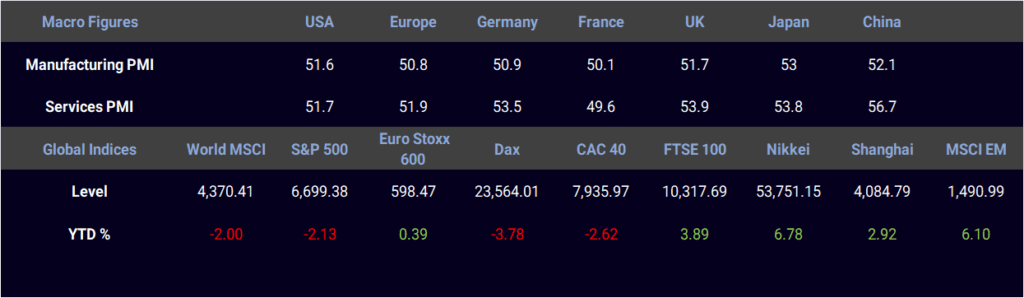
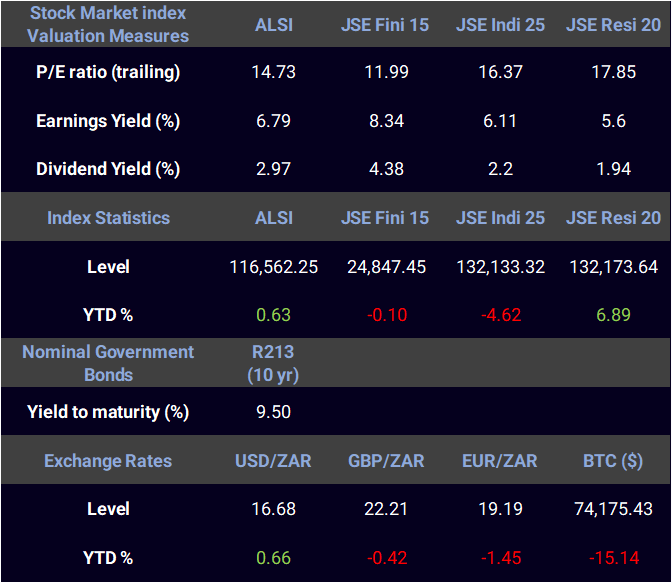
Make use of the many indicators below simply by clicking on each of the dropdown menus provided
Edit Content
Edit Content
Reference: Capital Economics – Historical bond and equity return data.
Invest Today
Spend some time with our team to find out which one of our portfolios is best for you!
